

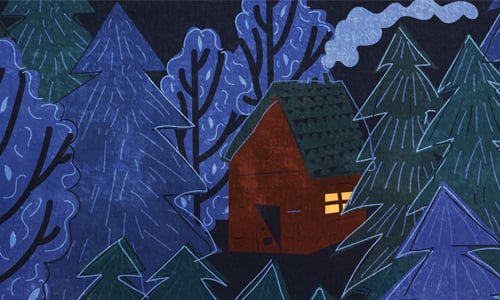
A widely held belief, often found in Jewish stories, is that there are 36 hidden tzaddikim—righteous individuals whose quiet, unrecognized merit sustains the world. These lamed-vavniks (the Hebrew letters with the numeric equivalent of 36), as they’re sometimes called, have become the subject of countless tales and legends.
While there are clear sources for the ideas of hidden tzaddikim and 36 tzaddikim who sustain the world, the idea that there are specifically 36 who must be hidden is more elusive. In fact, a closer look at the sources reveals that this commonly held belief may be a fusion of two independent concepts.
Let’s take a closer look at where these ideas originate and how they came to be linked together.
How Many Righteous in Each Generation?
The origin of specifically 36 tzaddikim seems to be a statement in the Talmud:
Abaye said: The world has no fewer than thirty-six righteous people in each generation who greet the Divine Presence, as it is stated: “Happy are all they who wait for Him [lo].”1 The numerical value of lo, [spelled lamed vav], is thirty-six.2
At the same time, different amounts are given elsewhere. The Zohar3 and Jerusalem Talmud4 give the number as no less than 30, while the Babylonian Talmud states that “there are the forty-five righteous individuals in whose merit the world continues to exist … thirty in the land of Israel and fifteen in Babylonia.”5
And in the Tikunei Zohar we read that there are 72—corresponding to the 70 members of the Sanhedrin along with Moses and Aaron—with half, 36, in the Land of Israel, and the other half in the Diaspora.6
While different explanations are given for the apparent discrepancies, it needs to be emphasized that even in the oft-quoted original source for there being only 36 tzaddikim, the Talmud itself continues:
… How can it be that there are only thirty-six tzaddikim [see above] who receive the Divine Presence daily? Didn’t Rava teach that the righteous stand in a row before G‑d that spans eighteen thousand parasangs—as it says, “It shall be eighteen thousand reeds round about …”7?
The Talmud answers: There’s no contradiction. Abaye was referring to thirty-six tzaddikim who perceive the Divine Presence through a clear, radiant lens [aspaklaria hame’ira], while Rava referred to the many righteous who perceive it through a dimmed lens [aspaklaria she’eina me’ira].
But then the Gemara challenges: Are even those who see through a radiant lens so numerous? Didn’t Rabbi Shimon bar Yochai say: “I’ve seen the spiritually elite, and they are few. If there are a thousand, my son and I are among them. If a hundred, still us. If only two—it’s just my son and me”?
The Talmud resolves: Abaye spoke of those who enter to perceive the Divine only with permission [bar] from On High, while Rabbi Shimon referred to the rarest tzaddikim who may enter without needing permission—those for whom the gates of Heaven are always open.8
Five Types of Tzaddikim
Based primarily on the passage quoted above, in addition to other sources, the Rebbe explains that there are generally five categories of tzaddikim:9
- Tzaddikim who behold the Divine through a non-illuminated lens (aspaklaria she’eina me’ira)—whom the Alter Rebbe (in the Tanya) refers to as “incomplete tzaddikim.” They number 18,000.
- Tzaddikim who gaze through an illuminated lens (aspaklaria hame’ira), yet only “enter with permission”—these are the 36 tzaddikim.
- “Complete tzaddikim,” who not only see through the illuminated lens but also “enter without permission”—these are the bnei aliyah, few in number but never fewer than two.
- The singular tzaddik who is the foundation of the world (tzaddik yesod olam). The world’s very existence depends on him; there is only one such tzaddik per generation.
- A complete tzaddik who purifies the world to the extent that the Divine covenant (symbolized by the rainbow) need not be invoked. Such a tzaddik is exceedingly rare and exists only in select generations.
Hidden Tzaddikim
After explaining that there are a certain number of righteous individuals in each generation, the Talmud continues, “Abaye said: Most of them are found in the synagogue beneath the gallery (or balcony).”10 In other words, don’t assume the righteous are all prominent figures. On the contrary, most are unknown—humble individuals who sit quietly in the back corners of the synagogue, unnoticed and uncelebrated by others.11
Similarly, the Midrash expounding on the verse in Daniel, “... and they that turn the many to righteousness (will shine) as the stars forever,”12 states that, “Just as the stars are high and exalted above all mortals, so are the righteous. And just as the light of the stars can be seen from one end of the world to the other, so the light of the righteous. And just as the stars are sometimes revealed and sometimes concealed, so the righteous …”13
The Organization of Hidden Tzaddikim and the Chassidic Movement
As we have explained, every generation is blessed with righteous individuals, but many are hidden from the masses. As the darkness of exile grew thicker, the hidden tzaddikim established a society of sorts, which was the forerunner of the Chassidic movement.
The Sixth Rebbe, Rabbi Yosef Yitzchak Schneerson, of righteous memory, describes how the organization came to be:
Already in his youth, Rabbi Eliyahu Baal Shem of Worms had mastered the profound teachings of Kabbalah. Gifted with clarity of thought and powerful communication skills, he succeeded in spreading these teachings to the wider Torah community. Thanks to his influence, many yeshivot of the time—such as those in Worms, Prague, and Lublin—began incorporating Kabbalah into their curricula, once students had a strong foundation in the revealed aspects of Torah.
To further this mission, Rabbi Eliyahu gathered a group of disciples and established a fellowship of Nistarim—hidden tzaddikim—who would live in self-imposed exile, wandering from town to town. Their dual mission was to uplift simple Jews through personal example and encouragement in serving G‑d, and to discreetly introduce Kabbalah to scholars.
These tzaddikim took on humble jobs—chopping wood, drawing water, and the like—to remain unnoticed while inspiring others with fear of Heaven and good character. Over time, the fellowship grew: first under Rabbi Eliyahu, then under Rabbi Yoel Baal Shem of Zamoshtsh, followed by Rabbi Adam Baal Shem of Ropshitz. Eventually, the leadership passed to Rabbi Yisrael Baal Shem Tov, who would bring its inner light to the world through the teachings of Chassidut.14
For more on the 36 tzaddikim, see here.



From childhood I have always sought wisdom and as I grew I felt that from conversations and observed behaviours that I was way ahead of the degree of wisdom that others my age showed. (I am not so sure that at my present older age that this still applies!)
Could it be possible that I might be one of these 36 tzadikim, even though I am practicing Judaism in not a particularly strictly orthodox and traditional way?