


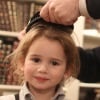
There is a widespread custom that a boy’s hair is left uncut for the first three years of his life. When he reaches his third Jewish birthday, family and friends gather for a festive first haircut known as the upshernish (or chalakah). While the rest of his hair is cut short, the child’s peyot (biblically1 mandated sidelocks) are left intact—this is his initiation into the mitzvah of peyot.2
More than a haircut, the upshernish marks a turning point: from this age, the child begins his formal Jewish education and starts observing basic mitzvot, such as wearing a kippah and tzitzit.3 Rooted in longstanding custom and rich symbolism, the upshernish celebrates a child’s entry into a life shaped by Torah and Jewish values.
While the actual ceremony is straightforward and can be read about in What to Expect at an Upsherin, let’s address some of the questions commonly raised about an upshernish.
Who Should Attend, and Where Should it Be Held?
Some have the custom to hold—or at least begin—the upshernish in a holy setting, such as a synagogue or house of study, but it’s perfectly acceptable to hold it at home or another neutral environment.4 Relatives and friends are invited to participate, since having a crowd present shows that this is a big deal.
What Does the Child Wear and Do At the Ceremony?
The child should wear tzitzit for the upshernish and continue wearing them regularly from that day on. He recites the verse Torah tzivah lanu Moshe, and other children may complete the set of 12 pesukim traditionally recited on such occasions. The child is also given money to place in a tzedakah box.5
Who Cuts the Hair?
You should honor someone special, like a rabbi or mentor, to take the first snip.6 On one occasion, the Rebbe advised beginning with a kohen, followed by a levi, and then a yisrael, after which others may participate.7 Men and women (provided that it is done in a manner that upholds the standards of modesty),8 relatives and non-relatives, can all be honored to take a snip.
Where On the Head to Cut First?
There are different customs about where to start cutting the hair. Some start at the area of the head where tefillin are worn. Others begin near the peyot, close to the ear, emphasizing the mitzvah of not shaving that area (this seems to be the custom of the Rebbe).9
Does All the Hair Need to Be Cut During the Ceremony?
No. You can finish it up later or have a (Jewish) barber do it for you, making sure the payot are left intact. The custom is to avoid having a non-Jewish barber finish the haircut.10
What Exactly Counts as Peyot?
The Torah commands, “Do not round off the edges (peyot) of your heads.”11 The Talmud explains that this refers to the hair between the temples and the ears; “rounding” means removing this area so that the hairline runs smoothly from the forehead to behind the ear. Practically, the peyot span from behind the ear to the forehead and include all the hair in front of the ear.12
How Long Should the Peyot Be?
Some authorities prohibit cutting the peyot very close to the skin even with scissors, while others hold that the Torah prohibition applies only to shaving with a razor. The Code of Jewish Law rules according to the latter view but advises stringency by not cutting too close.13
In practice, this means leaving the hair long enough that it can be bent over to touch its root—approximately 0.5 cm (about a #2 clipper). This is the minimum requirement; many choose to leave the peyot longer so they are clearly visible.14
For more on this, see What You Need to Know About Haircuts in Halacha
In many communities, peyot are grown long as a visible expression of Jewish identity, a practice found among Jews from widely different lands. Others, including Chabad, follow the custom of the Arizal,15 who would trim his peyot with scissors and not let them grow below the ear.16

Giving Charity
In addition to the general custom of having the child give charity at the upshernish, many have the custom to specifically give the child some money to place in a charity box before they snip the hair.17
What is Done With the Hair After It’s Cut?
The cut hair should be collected and buried, rather than thrown in the garbage.18 Some have the custom to weigh the hair and give an equivalent amount of coins to charity.19
Is There a Festive Meal?
While many mark the upshernish with a celebratory meal, you don’t actually need to serve a full meal; you can just have refreshments such as cake and l’chaim.20 The child is encouraged and given opportunities to recite blessings before eating. There is often singing and music to enhance the joy.21
Wash Your Hands
After the child's hair is cut, his hands should be washed (as is proper to be done after any haircut), similar to how the hands are washed in the morning (i.e., three times on each hand, alternating hands).22
When Should the Upshernish Take Place, and When is It Postponed?
Ideally, it is held on the child’s third Jewish birthday—neither earlier nor later.23 However, since haircuts are restricted at certain times, the upshernish may be postponed (but should not be done earlier):
- Shabbat and festivals: The upshernish is held immediately afterward.
- Intermediate days (Chol Hamoed) of Sukkot: If the birthday is on Chol Hamoed (intermediate days of the holidays), then, although ordinarily haircuts are prohibited, an upshernish is permitted to take place.24 Nevertheless, many have the custom to delay until after the holidays.
- Intermediate days (Chol Hamoed) of Passover: There are differences of opinion whether the upshernish should be held during the intermediate days of Passover, or whether the restrictions of the Omer have begun and one should wait until Lag BaOmer. Consult your rabbi regarding community custom.
- Sefirat HaOmer: If the birthday is before Lag BaOmer, the custom is to have the upshernish on Lag BaOmer. If it’s afterwards, then the upshernish is held shortly before Shavuot.
- The Three Weeks of mourning: If the birthday falls between the 17th of Tammuz and Tisha B'Av, the upshernish is delayed until after Tisha B’Av.
- Rosh Chodesh: The custom is to refrain from getting haircuts on Rosh Chodesh. As such, while some permit the upshernish, the common practice is to postpone until the following day.
What’s Next for the Child?
A father is obligated to begin teaching his son Torah as soon as the child is able to speak, starting with basic verses such as Torah tzivah lanu Moshe and Shema Yisrael. As the child matures, his learning expands, first at home and then in cheder under a teacher. While no fixed age is mandated, many communities begin formal schooling at age three, on or shortly after the upshernish.
For more on that, see Areinfirinish - A Child's Entry Into Cheder


Good Afternoon,
I am honored for Chabad sharing the important and meaningful ceremony of Upshernish that marks a young Jewish boy's entry into Abrahamic Covenantal relationship with GD [community] and proceeds to transition into Jewish heritage, education and learning, and "purpose." I've seen Jewish men and boys wear the piyot and know that it is a Torah levitical commandment, but now I understand its in-depth meaning, rite of passage, and the mystical revelation of what it means to be consecrated to GD, belong to a ancient heritage, culture, and people.
The Torah is now even more deeply moving to me.
Baruch HaShem,
🕊💜
Deeply Grateful