


Jews have their own customs, traditions, culture—and even languages. While you may have heard of Hebrew, Yiddish, and Ladino, there are actually many other Jewish languages as well. Sadly, most of them are now in decline. Read on for 11 Jewish languages.
1. Lashon Hakodesh (the Holy Tongue)—Biblical Hebrew
The first and eternal Jewish language is Lashon Hakodesh, the Holy Tongue. This is the language of the Bible—the language spoken by G‑d, with which He created, and continues to create, all of existence.1
Lashon Hakodesh was the widespread language of the Jews in the Biblical era, until the destruction of the First Temple. Although it was then largely replaced by Aramaic (see below), it continued to be spoken by Jews in the Holy Land until the 2nd century CE. And even once Jews were exiled to new lands and adopted new everyday languages, young and old continued to study holy texts in their original language—ensuring that Lashon Hakodesh always remained at the forefront of Jewish minds and hearts.
2. Yiddish

When Jews first settled in what is now Germany in the 9th–10th centuries, they developed their own language—one that was linguistically similar to German, while incorporating many Hebrew and Aramaic elements. As Jews moved eastward to Poland and Russia, they took Yiddish (lit., “Jewish”) with them, where it continued to develop and thrive. And it still thrives today, especially in Chassidic communities.
Yiddish is known for its colorful, vibrant expressions and aphorisms, making any conversation with an authentic Yiddish speaker a real treat for both ear and mind.
Read: 13 Facts About Yiddish
3. Ladino
With roots in pre-Expulsion Spain, Ladino developed as Sephardic Jews settled in and adapted to their new countries. Ladino was once the primary language of Jews across much of the Mediterranean basin, spreading from there to places like Romania, France, the United States, and Latin America.
Although the language has declined over the past 150 years, it has recently been making a slow but steady comeback.
Read: Will Ladino Rise Again?
4. Aramaic
While Aramaic was spoken in several non-Jewish communities as well, it's certainly a language with strong Jewish ties. Parts of the Bible are written in Aramaic, as are the Talmud, Zohar, and several liturgical texts (such as the Kaddish prayer).
The Jewish community adopted Aramaic when they were exiled to Babylonia in the 5th century BCE,2 developing a unique dialect which served as the Jewish lingua franca for well over a millennium.
Fun fact: Kurdish Jews continued speaking Aramaic as recently as several decades ago!
Read: 11 Facts About Aramaic
5. Ivrit—Modern Hebrew
At the end of the 19th century, Hebrew as a spoken language began to gain momentum once again. Today, it is the national language of Israel—and in fact, it is the only language in history to have successfully undergone a large-scale revival.
Because of dramatic changes in vocabulary, grammar, and syntax, many scholars consider Modern Hebrew (Ivrit) a distinct language from Biblical Hebrew.
Read: The Hebrew Alphabet
6. Judeo-Arabic
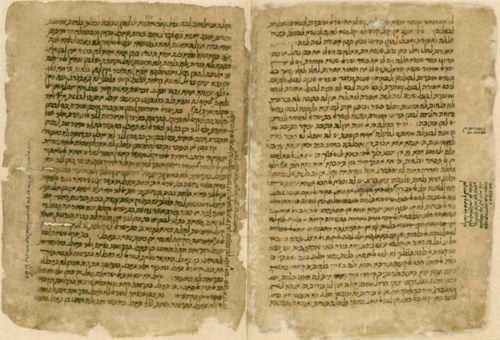
With the Muslim conquest of Mesopotamia in the 7th century, many Jewish communities found themselves under Arab rule, requiring them to adapt to a new culture and language. In the centuries that followed, Jews in Arab lands developed unique Jewish dialects of Arabic, known collectively as Judeo-Arabic.
Many important Jewish works were originally written in Judeo-Arabic using Hebrew characters, including Rabbi Saadiah Gaon’s Emunot V’Deot, Rabbi Bachya ibn Pekuda’s Duties of the Heart, and Maimonides’ Guide for the Perplexed.
7. Judeo-Persian

Judeo-Persian is a collective term for the various dialects of Persian spoken by Jews in Persian lands. While these dialects were often mutually intelligible with the speech of their non-Jewish neighbors, Jews sometimes wanted a way to speak privately in the presence of strangers. To do this, they used Lotera’i (meaning “not [the language] of the Torah”)—a form of speech in which Hebrew and Aramaic loanwords were deliberately maximized, allowing it to serve as a kind of secret code.
This includes Juhuri—also known as Judeo-Tat—the traditional language of the Mountain Jews of the Caucasus. This language is clearly related to modern Persian, with which it shares a common ancestor.
8. Extinct and Endangered Jewish Languages
Throughout history, Jews developed dialects of local languages wherever they lived. Sadly, most of these are now either extinct or spoken by only a handful of people. A few examples include:
- Judeo-Provençal, in southern France
- Judeo-Malayalam, spoken by the Cochin Jews of India
- Judeo-Roman, in Rome, Italy
- Yevanic, spoken by the Romaniote community in Greece
9. Judeo-Georgian (Gruzinic) and Bukharian
While many of the languages on this list are almost—or already—extinct, Judeo-Georgian, the dialect of Georgian spoken by the Jews of Georgia in the Caucasus, still has quite a few speakers. About 80,000 Jews speak this language today, with most living in Georgia and Israel. Bukharian, the language spoken by the Bukharian Jews of Uzbekistan, has a similar number of speakers.
10. Jewish Loanwords in Other Languages
Many Hebrew and Yiddish words have made their way into other languages. For example, English dictionaries now include a host of Yiddish words such as mensch, chutzpah, klutz, and kvetch. And Llanito, the local Spanish dialect of Gibraltar, contains several words of Hebrew origin—such as maot (money), haham (know-it-all), and bezzim (eggs).
11. English?!
From a Kabbalistic perspective, by using foreign languages for holy purposes, Jews elevate the sparks of holiness hidden within them.3 Perhaps this also explains why Jews created their own dialect of nearly every local language they encountered throughout the Diaspora.
English seems to be a notable exception—although I’ll argue that my kids have their own dialect, which may explain why my neighbors can’t understand them! Still, English (like many other global languages) is being elevated as well, by being used to study and spread Judaism, Torah, and Chassidism. In that sense, perhaps it, too, can be viewed as a Jewish language.
Read: Freeing the Trapped Sparks
* * *
Do you speak any of these—or other—Jewish languages? Please share with us in the comments!




Join the Discussion