


Everyone knows that bagels and lox or pastrami on rye are New York classics. It’s a place where just about everyone uses Yiddish words like schlep and kvetch as well. Did you ever wonder why?
After Israel, nowhere on Earth has more Jewish life packed into one place than New York City. From the teeming Lower East Side of 1900 to the vibrant Borough Park of today, New York and Jewish life have grown so closely intertwined that it’s hard to imagine one without the other. Read on for 14 fascinating facts about this lively, colorful, and bustling community.
1. The First Community Was Sephardic

The very first Jews to found a Jewish community in New York—then New Amsterdam—were Sephardic refugees from Brazil (the first recorded Jew was actually an Ashkenazi, Jacob Barsimson, who arrived a month earlier). When the Portuguese seized Brazil from the Dutch in 1654, they brought along the Inquisition, leaving Jewish residents with no choice but to flee. A small group sailed north to New Amsterdam, where they met stiff resistance from the colony’s antisemitic mayor, Peter Stuyvesant. Nevertheless, they persevered, establishing Congregation Shearith Israel, the first Jewish congregation in what is now the United States.
Take the American Jewish History Quiz
2. Eastern Europeans Came in Droves

For two centuries, New York’s Jewish community—made up of both Sephardic and Ashkenazi Jews—remained quite small. But all that changed toward the end of the 19th Century. As life grew more oppressive in Tsarist Russia, over two million Jews left between 1880 and 1920, with roughly half settling in New York. By 1920, more than 1.5 million Jews lived in the city, nearly one-third of the entire population.
Watch: Russian Jews Under the Czar
3. The Lower East Side Was the Capital of Jewish America

At the turn of the 20th century, the Lower East Side became the first stop for countless new arrivals from Eastern Europe. A freshly arrived immigrant stepping onto its crowded streets would find themselves surrounded by a familiar Jewish world: synagogues on nearly every block, Yiddish signs in shop windows, and mutual aid societies ready to help. Until the 1950s—when residents began moving to other neighborhoods—the Lower East Side held the largest concentration of Jewish life anywhere since Temple times.
Read: 13 Facts About Yiddish
4. Jews Were at the Center of the Labor Movement

Job options for Jewish immigrants were limited. Many men, women, and even children found themselves in hot, cramped sweatshops, sewing garments for up to 17 hours a day in dangerous conditions. Refusing to accept such hardships, Jewish activists became leaders in the fight for workers’ rights, organizing strikes (such as the famous 1909 “Uprising of 20,000”), forming unions, and pushing for reforms. Their efforts helped shape many of the labor protections we consider standard today.
5. Its Earliest Yeshivah Is Over a Century Old

New York’s first yeshivah opened in 1896: the Rabbi Isaac Elchanan Theological Seminary. Founded to offer traditional Torah education and rabbinic training, it eventually grew into today’s world-renowned Yeshiva University. Other pioneering yeshivahs soon followed, including Yeshiva Torah Vodaas, Yeshiva Rabbi Chaim Berlin, and Mesivta Tifereth Jerusalem.
Read: What Is a Yeshiva?
6. Brooklyn Is a Center of Jewish Life
As the 20th century began, Brooklyn drew both new immigrants and those looking to move out of the crowded East Side. East New York and Brownsville became thriving Jewish neighborhoods—Brownsville even earned the nickname “the Jerusalem of America.” Today, Brooklyn remains the heart of Jewish New York, home to the largest Jewish population in the country.
7. Different Neighborhoods Attracted Different Demographics
Different parts of New York City have been the home base for different Jewish communities from around the world. German-speaking Jews formed K'hal Adath Jeshurun in Washington Heights. Brooklyn’s Gravesend neighborhood is home to a large and close-knit Syrian Jewish community, while Queens’ Forest Hills hosts a prominent Bukharian community. Jews from the former Soviet Union can largely be found in South Brooklyn, in neighborhoods like Coney Island and Brighton Beach. Williamsburg, Crown Heights, and Borough Park host the largest Chassidic populations outside of Israel.
8. The Rebbe Led World Jewry There for 40 Years
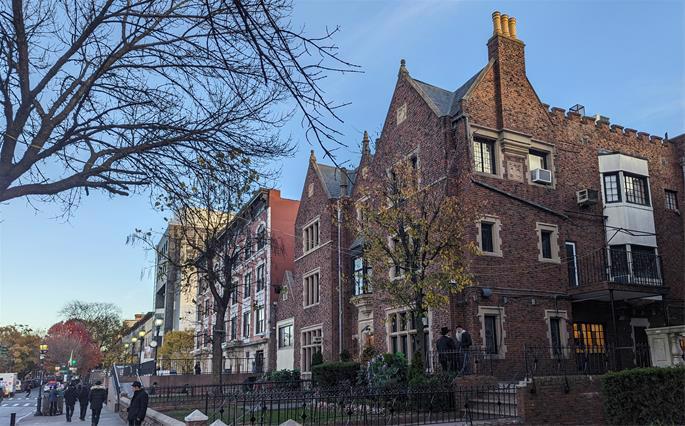
In 1940, the Sixth Chabad Rebbe, Rabbi Yosef Yitzchak Schneersohn, arrived in New York and soon settled in Crown Heights. His son-in-law, Rabbi Menachem Mendel Schneerson, joined him the following year. After Rabbi Yosef Yitzchak’s passing in 1950, his son-in-law—known to the world simply as “the Rebbe”—became the leader of the global Chabad movement. From the now-famous building at 770 Eastern Parkway, he guided and inspired world Jewry for the next 40 years, drawing thousands of visitors each year who sought his blessing and advice.
9. Four New York Mayors Were Jewish
Jewish New Yorkers have long played an active role in city politics, including sitting in the mayor’s seat. Fiorello La Guardia—one of the city’s most famous mayors—was the son of an Italian-Jewish mother. Later, from 1974 to 1989, the city elected two consecutive Jewish mayors, Abraham Beame and Ed Koch. Michael Bloomberg, who served from 2002 to 2013, became the city’s fourth Jewish mayor.
10. Jews Don’t Run!
In the 1960s and 70s crime spiked, prompting mass flight and urban collapse. The Rebbe took a stand, declaring that Jewish law forbade abandoning a community. It endangered the poor, elderly, and infirm who remained. Rabbi Moshe Feinstein, the leading halachic arbiter of the 20th century, supported the Rebbe in the strongest terms: “Had [the Rebbe] not written already on this subject, I would have written almost the same thing on my own. This is the truth, and it must be publicized.”
11. The Mitzvah Tank Was Born There
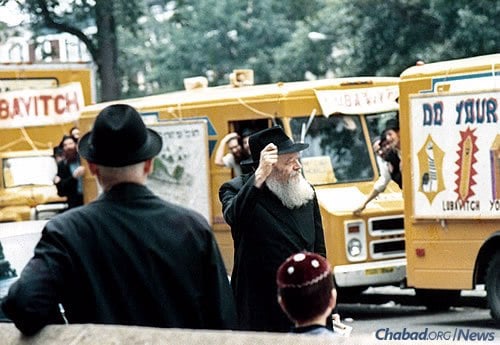
Those iconic “Mitzvah Tanks”—mobile Jewish centers that bring mitzvah opportunities out to the street—got their start in New York. In 1974, a group of young men outfitted a small truck with Jewish signs and items to support the newly launched Mitzvah Campaigns. These rolling centers of Jewish outreach were an instant sensation, and they still roam the streets in Manhattan and beyond.
12. There Are 110,000 Kids in Jewish Schools
In the early 1900s, very few Jewish day schools existed in the city, and most Jewish children attended public school. Many participated in the Wednesday “Released Time” program, which offered a small dose of Jewish learning—but nothing close to a full education. Today, the landscape has changed dramatically. With hundreds of Jewish schools across the five boroughs, more children than ever are receiving a full Jewish education, with about 110,000 students currently enrolled.
Read: Jewish Education—How It Came About and What It Is Meant to Be
13. The Ohel Attracts Visitors From All Over

One of New York’s most visited Jewish landmarks is the Rebbe’s resting place, known as the Ohel, located in Cambria Heights, Queens. Hundreds of thousands of people visit each year—some making the trip to New York solely to pray there. Visitors include chassidim, Jews from all backgrounds, and many non-Jews as well, all seeking blessing, encouragement, and spiritual inspiration.
14. Jewish New Yorkers Established New Communities
In the 1960s and 70s, shifting demographics led many Jewish families to relocate from the city to places like Long Island and New Jersey, where they established new, flourishing communities. Today, Jewish New Yorkers can be found in growing communities across North America and around the world—yet New York itself remains the largest and most vibrant Jewish community in the Diaspora.


In the late 1940s, my public school, P.S. 99 in Brooklyn, released interested students to a local “storefront” synagogue for Religious Instruction. Growing up in a secular household, that was to become my only Jewish education.