

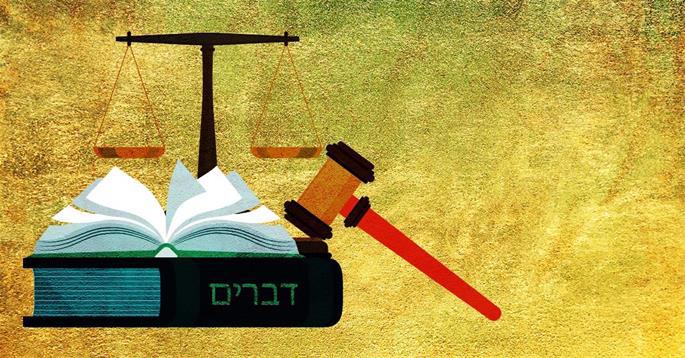
A beth din (also spelled beit din or beis din) is a Jewish court of law that helps resolve disputes and directs many areas of Jewish life. From the great Sanhedrin in Temple times to the beth din of today, these courts have always played an important role in Jewish life. Read on for 11 facts about this eminent institution.
1. It’s a Mitzvah to Appoint Them—And Listen to Them
Jewish courts aren’t just a practical necessity—they’re a Torah obligation! The portion of Shoftim instructs us to “appoint judges and officers in all your gates.”1 And once they issue a ruling, it’s a mitzvah to follow it: “Follow the teachings and rulings they give you; do not sway from what they tell you to the right or to the left.”2
Read: What Is a Beit Din?
2. They’ve Been Around Since Sinai
Jewish courts go way back—all the way to Mount Sinai. From the time we received the Torah, courts of law were an essential part of Jewish life. Giants of Jewish history like Moses, Joshua, Samuel, and King David personally led courts,3 taking an active part in settling disputes and issuing rulings.4
Read: What Is the Torah?
3. There Were Once “Sanhedrin”
In Talmudic times, high-level courts were known as the Sanhedrin, from a Greek word meaning “assembly.” It has meaning in Hebrew too: “Sanhedrin” is a composite of the term sonei hadrat [panim]—“despising partiality,” a trait every judge must have.5 With the abolition of semichah (see below), Sanhedrin no longer exist. Today’s courts go by the basic name beth din (“House of Law”) instead.
Read: The Sanhedrin
4. They Require an Odd Number of Judges
Jewish law requires that a court have an odd number of judges. Why? To avoid a tie! If the judges disagree, the verdict follows the majority.6
Watch: Majority Rule
5. They Used to Be Three-Tiered
When the Holy Temple stood in Jerusalem, there were three levels of courts:7
| Name | Number of judges | Location | Function |
|---|---|---|---|
| Beit Din Hagadol (Supreme Court) | 71 | Courtyard of the Holy Temple in Jerusalem | Ultimate authority in all matters of Jewish law. Certain high-level cases could only be judged here |
| Sanhedri Ketanah (Small Court) | 23 | Two on the Temple Mount, plus in every large city | Capital, corporal, and monetary cases |
| Beth Din | 3 | Every city | Corporal and monetary cases |
Today’s courts are essentially a scaled-down version of the lowest tier (more on this below).
6. Not Just Anyone Could Be a Judge
To sit on the Sanhedrin, you had to be wise, humble, G‑d-fearing, honest, money-loathing, truth-loving, beloved, and have a good reputation. In addition to extensive Torah knowledge, you needed some expertise in disciplines such as medicine, math, and astronomy, so you would know how to judge cases concerning those fields. And you couldn’t be childless or too old, since someone with a family is more likely to be sympathetic.8
Fun fact: Judges in the Sanhedrin were fluent in many languages, so they could hear cases directly without interpreters.9
7. They Were Guardians of Tradition
When G‑d gave the Torah at Sinai, He also gave the Oral Torah—explanations and traditions that clarify the written law. These teachings were passed from generation to generation through the central beth din of the time. From Moses to Rav Ashi (who redacted the Talmud), there were 40 central beth dins, forming an unbroken chain spanning 1,800 years that preserved the Oral Torah until it was recorded in the Mishnah and Talmud.10
8. Today’s Courts Have Less Power …
Back then, a court could impose capital punishment, corporal penalties, and special fines—but only if its judges had a special ordination called semichah. This ordination could only be granted in the Land of Israel by someone who had received semichah himself, in an unbroken chain of authority going back to Moses.11 That chain ended during the persecutions of exile (the exact time is somewhat murky), and with authentic semichah extinct (until the Messianic era), the beth dins of today don’t wield the same level of authority.
9. … But They’re Still Very Important
Despite these restrictions, modern beth dins are deeply involved in Jewish life. Among their many responsibilities:
- To resolve disputes between individuals
- To oversee conversions to Judaism
- To handle Jewish divorces
- To provide guidance in various areas of Jewish life
10. They Are Presided Over by an Av Beth Din
The senior figure in a Jewish court is called the Av Beth Din (Head of the Court). The term is borrowed from the Supreme Court of old, which was headed by a Nasi (leader) and his deputy, the Av Beth Din.12 Although today’s Av Beth Din does not have the same authority as his namesake, the post is usually filled by a venerable scholar whose word carries considerable weight.
11. There’s No Jury
Unlike in American courts, there’s no jury in a beth din. The judges themselves hear the case and issue the verdict. And instead of lawyers, litigants can employ the services of a to’en, an expert in Jewish law who helps present their case.
Now take our Beth Din Quiz



Would not today of all days be the proper one to wake up the call for a Sanhedrin?