





The classic work of chassidic thought known as Tanya is principally a guide to meditation and prayer. It’s a treasure of knowledge concerning the dynamics of human intelligence. Most significantly, it shows you how to use these dynamics for internal change.
Here’s a fascinating insight from the third chapter with some elucidation. Of course, this is all according to my feeble understanding, tapping into the many discussions in Chabad teachings that touch on the subject, as well as the explanations given me by my teachers.
The Ability of Whatness
The intelligence of the thinking soul, the faculty that enables her to conceive any idea, is called חכמה chochmah, which can be read as כח מה ko’ach mah [potential of “what?”].
When you actually exercise this potential, contemplating with your intelligence so that you will understand an idea thoroughly and plumb its depth—that is called binah.1
That first line is rather cryptic and could leave you hanging in midair. Is chochmah just the ability to think—a raw potential—or does it actually conceive ideas? And what is “the potential of what?”
Let’s unravel this, bit by bit:
“What?”—as in, “What is this?”—is the paradigmatic question. It is the state of your mind as it stands just before the threshold of understanding and knowledge. You know, but you don’t know what you know. What you observe is not entirely knowable. In fact, as a whole, it is entirely unknowable.2 But you ask, and from the question, you gain the ability to know some meaningful glimmer of what you know—a potential.
Here we are told that this is the core of intelligence, where it begins and what drives it.
There’s a lot to unpack here, so let’s begin by looking at this from within real-life experience.
Teach Me What I Know
Throughout your life, you came across chochmah many times and subsequently turned it into binah.
When you were little, they taught you how to count, perhaps using your fingers. “One little finger, two little fingers…”
That was chochmah.
At some point, you began to count how many cookies you had, how many people were at the table, and many other things.
That was binah.
One day, the adults pointed out that one plus one equals two. If they were smart, they demonstrated: Hold up one finger. Hold up another finger. Two fingers! Being a child, you may have exclaimed, “I knew that!”
Another chochmah.
With this chochmah, you discovered new power. Because if one plus one equals two, then two plus one must equal three. And then, two plus two equals four.
Binah kicked in.
Things got bigger and the stakes rose. Perhaps at some point they told you that you have a soul. That sounded right to you. Eventually, you began to think, maybe even ask them questions, like “What is a soul? Where does it come from? What is it made of?” From this chochmah they gave you, you entered binah.
Your mother may have told you there is a G‑d. You believed her. When you wanted something badly and neither she nor your father would give it to you, you went straight to G‑d. Then, one day, you began to wonder and pester adults with questions: “What is G‑d? Where is G‑d? What does G‑d look like? How do we know there is a G‑d?” You began binah.
All these four instances of chochmah—counting, the accumulative principle (1+1=2), the soul, and the notion of G‑d—have something in common:
In each instance, no one really taught you anything you didn’t know. They only showed you, or articulated for you, something you already had inside you. It was there, but only in a potential state. Their demonstration, or articulation, brought it out into reality.
When you said, “I knew that!” as a child, you weren’t being silly or obnoxious. If you had no notion inside you of labeling perceptions with words, you would never have learned language—and that includes counting. If you had never intuitively known that one finger and another finger makes two fingers, nobody would be able to teach it to you.
You knew it—but you didn’t know that you knew it.
The same with a soul. The notion made sense to you because you experienced it—but you had no way to articulate that experience.
When it came to the notion of G‑d, it was likely the same—as well as with many other nuggets of chochmah that resonated with you as soon as you heard them. They struck a chord within you, like the crystal glass that vibrates when you hit the right note. Something within you was already set for that frequency, just waiting for the note to be played.

Show Me
That’s all it means to teach someone something: You don’t teach by uploading information into another person’s brain. Rather, you show them something.
It’s as though you were pointing to a corner of the room and saying, “See there, just at the foot of the bookcase, on the carpet, fuzzy and white with glowing eyes? That’s a cat.” And they say, “Yes, I see it. I saw it all along. Is that what you call it?”
Only that, when teaching chochmah, rather than a cat visible to the student’s eyes, you show them an idea that was lying there in their chochmah, hiding in plain sight.
Sometimes, nobody has to teach you what’s up there in your chochmah. Sometimes, you find it there yourself.
You might be struggling with a problem until you’re about ready to give up—and then a flash of insight lights up your mind. Suddenly, everything fits together.
Where did that flash come from? The same place that was resonating inside in all those other instances. Only that this time, you brought it out yourself. You entered a cavern deep within yourself and carved out a piece of the great unknown.
That is a good description of the creative act: Carving out a little something from the infinite sea of the unknowable.
Portal of the Soul
We call that place by the same name we call everything that comes out from it: chochmah. As Rabbi Schneur Zalman implies here, everything you will ever understand resides first in chochmah, but as “mah?”—meaning “what?” It’s there in a state that doesn’t yet have a form to know it by, a handle to grab onto it, or words by which to manipulate it.
Chochmah, then, is a portal from the subliminal soul into your conscious world, taking in the unknowable and allowing subtle droplets of it to seep slowly, over a lifetime, into the known.
It’s strikingly similar to how your eye sees. Your optic nerve carries an immense amount of potential data from your retina to your brain. There is no way your mind can process all that data, and most of it is of no practical use. So, even before you are aware of what you are seeing, your mind has parsed away all the unnecessary stimuli and handed you a neat, manageable reconstruction of your visible surroundings.
Similarly, there’s a place in your soul that takes in everything. Your conscious mind can’t handle everything, but treading softly on its tiptoes, eyes open wide, chochmah can.
The Quiet Canyon
Here’s a story that might illustrate tiptoe thinking:
David Fleishman was hitchhiking in Arizona when a car pulled up, full of young people his age. He jumped in and squeezed himself into the back seat. When they asked where he was going, he said, “Grand Canyon, of course. I’ve never seen it.”
His newly found friends said they’ll take him there and they’ll make it special. One of them removed his sweatshirt and tied it over David’s eyes.
After an hour of climbing and swerving, David felt the car pulling over onto the gravel. The door opened. One friend held his left arm, the other held his right.
“Take a few steps forward. One more. Okay, stop.”
The blindfold came off. Two arms continued to hold him tight.
“I can’t tell you how long I stood there,” David recounted decades later. “There was no time. I had no idea what my eyes were seeing, whether it was close or far, a painting or for real. All I knew was that I must not try to understand. I needed to only stand quiet and still until, eventually, gradually, the rocks said they were rocks, the cliffs said they were far, the canyon said it was deep below, and each thing slipped neatly into its place.”
David was seeing something entirely new to him. He had no context or precedent to work from. Intuitively, he knew he could not engage binah until chochmah had done its job.
Chochmah’s refusal to do anything is its greatest advantage. As soon as you begin processing whatever you see, you’re no longer seeing, you’re interpreting. As dissection kills a living subject, interpretation can rapidly annihilate truth.
The Letter Yud
That explains why the great insights of chochmah occurs at the moment of surrender. You struggle to understand, but no solution is satisfying, nothing fits where it is supposed to go. The world as you have structured it is rapidly crumbling to dust along with your ego. Then, in the darkness of that moment of despair, an insight suddenly flashes. Suddenly, everything can make sense.
What happened?
As long as you dwelt comfortably in the castles of logic constructed by your mind, there was no room for truth to enter. Only when those structures tottered, and your self-concept with them, only then could raw reality enter through the crack in the wall, if just for a fleeting moment.
Chochmah is just that: Your mind grabbing light in the raw, holding it in its potential state and allowing you a glimpse of reality untampered.
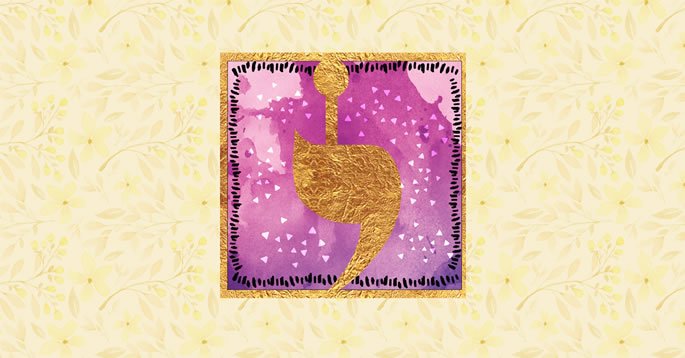
Among the Hebrew letters, chochmah is represented by by the letter Yud . A yud is essentially a point. But, under a microscope, you’ll note that this point has a small and thin line dropping downward, and an even smaller line, just a small spike, reaching upward.
Chochmah reaches upward to see that which is entirely beyond knowing. That’s the spike at the top of the yud. It snaps a shot of that infinite, unknowable light from beyond. That’s the body of the yud, the dot. And, at times, it releases a glimpse of that snapshot to binah–that’s the tiny line flowing down from the yud.
The body of the yud is the mah. It remains unknowable, entirely beyond the purview of binah, much like a point that has zero dimensions and occupies no space. The small extension downward is the ko’ach, a potential for understanding fished out of this unknowable place.
True chochmah, then, is the ability to sustain astonished wonder and not rush to answer; to question and savor the question, the mystery, as you would the bouquet of a fine champagne before attempting to gulp down an answer, knowing full well that a good question provides far more than any answer. Chochmah is the admittance of our incapacity to ever genuinely know, the wisdom to feel helpless before the reality that is essentially unknowable.
Which is what makes chochmah the point from which all knowledge begins.

Father Thinking, Mother Thinking
Yet if you remain at chochmah, you own nothing.
Chochmah is the father; binah is the mother. Without a mother, there is no life.
Chochmah is power, yet impotent alone. It is a kind of knowledge without form, without handles to grasp it by, as elusive and unreliable as air between clapping hands. Like the male sperm, a flash of chochmah left unabsorbed and unprocessed rapidly disintegrates to dry, useless matter—and then vanishes from memory as though it never was.
Binah is when you grab that seed of wisdom, incubate it, nurture it, and allow it to unfold into an entire, viable, living being. Binah is the womb where chochmah gets a life, where potential gets real, where a simple, dimensionless point becomes a full-blown, three-dimensional work of art, much as a zygote evolves to become an entire person in nine months of gestation
Binah is also something people don’t do a lot of today, mostly because it takes a lot of time and avoidance of distractions. The notion of thinking about things you already know seems to many a waste of time. Here, R. Schneur Zalman tells you it’s your wisest investment. It’s the only way you can come to face the world standing on your own two feet.
Rabbi Isaiah Horowitz (c. 1555-1630), in his classic compendium of Jewish thought, Shnei Luchot Habrit, explains:
The verse goes, “This is my G‑d, and I will call Him beautiful; the G‑d of my fathers, and I will exalt Him.”
When is He my G‑d? When He is my G‑d because I’ve thought about Him and know Him on my own. Then the two of us are bound together.3 Because when I realize something on my own, it sticks to my heart.
But when I do not know Him through my own understanding, when my knowledge is only due to received wisdom—as “the G‑d of my fathers”—then, “I will exalt Him.” Meaning, He will always remain far beyond me, and in my innermost heart, I will remain distant from Him.4
The Talmud tells of the robber who has dug a tunnel into someone’s mansion and is primed to break in, loot and plunder, maim and kill if necessary. Just before knocking down the final wall, he cries out, “G‑d help me!”5
Does the robber know there is a G‑d that he can call upon in time of need? Yes. So why doesn’t he call upon G‑d to provide his needs honestly and safely, without having to risk his life and the life of his prey?
Because his belief is all up in chochmah. His faith has a father, but no mother.

Inside the Womb of Binah
The first step of binah is to capture that flash of chochmah in its net without annihilating it. To accomplish that, chochmah must remain binah’s partner throughout. They are a monogamous couple, as the Zohar describes them, “Two lovers that never part.”
Binah keeps on solid footing by ever referring back to chochmah, assuring that its exploration is on track, its assumptions are not unjustified, and the essential point has not been compromised. And chochmah is in turn informed by binah, stimulating yet more flashes of insight.
As with chochmah, binah’s key strategy is to ask good questions. “Where does this idea lead to? How does it affect everything else I know? What makes it true? What makes it powerful? How does it change my view of the world?”
When your binah really gets going is when you ask the question, “How will I explain this to absolutely anyone without watering it down?” But, as with any structure, you can’t reach very far unless you also have breadth and depth.
Depth requires abstraction, ripping away the outer layers of any idea to find what ticks inside it. You ask, “What does it really mean? What is the essential point here?” You’re referring back to your chochmah, grasping for its core, for what it really sees.
You know you’ve gotten to that point when you discover you can spread this building out wider and broader, dressing the same ideas in multiple sets of clothing, telling the same story with different narratives, providing yet more metaphor on multiple levels and more applications in real life.
When all you have is the idea as you received it, it’s like a well of water. Dive deep into that well, find its true origin, and your well becomes a spring of living waters that spreads out far and wide.
Ultimately, the goal of any contemplation is to bring that light of chochmah all the way down into your heart, and from there outward into your daily life. For that, you’ll also need da’at.
It’s Your Father
Your mind is a powerful tool, but thoughts alone will not change you. Even the most brilliant and meticulously developed insight could end up just another fantasy to hang on the wall.
Until you step inside the picture.
Michel Blinner “the Elder” of Nevel would chide his listeners for studying Tanya and chassidut “as though it were a letter from a stranger about events up in the heavens.” He made his point with this story:
An illiterate homesteader, like many such simple Jews, brought a teacher to live in his home and tutor his children.
One day, a letter arrived for this simple Jew. It looked important, so he ran to the teacher and asked him to read it to him.
The teacher read, “We are grieved to inform you that your father has passed away.” And he continued reading the rest of the letter out loud—oblivious to the fact that the homesteader had fainted and lay on the ground.
Of course, the teacher sympathized. But he didn’t faint, or even cry. Why?
The reason is obvious. The letter was not about his father.
Michel would conclude: But these thoughts you contemplate, these wonders your mind attempts to swallow, they are about your father.6
This is da’at: your very personal connection to whatever concept you are thinking.

Da’at, the Midwife
Chochmah and binah are about an idea. Da’at is about you. Dawn has broken, you awaken to a new day, and your past was a dream.
Chochmah is the intellectual equivalent of seeing. Binah is hearing. You can see or hear from afar, aloof, unmoved. Da’at is touch, getting inside a thing, palpably sensing its texture, its warmth or its chill, and being moved by it. You cannot touch a thing without it touching you. And with that touch, it is no longer and abstraction. It has become real.
That is why da’at is both the midwife and nursemaid of human emotion. It is you standing over your mental faculties and saying, “This matters to me. I’m not letting go. I can’t go on until I’ve got this down.”
And it is you, having delved deeply into that understanding, saying, “If this is so, I can no longer be who I was.”
Da’at and Maturity
Perhaps a better term for this state of truly knowing is realization. Ideas on their own are impotent. But once an idea has moved from an abstraction to a realization, the tectonic plates of your psyche shift places. Your mind and heart find themselves in a different world and can never return. It is no longer an idea. It is a part of who you are.
That’s why many people’s da’at may not be commensurate with their intelligence. A child may be very intelligent, sharper than the adults. Yet the Torah does not hold that child responsible for his or her actions. Until around the age of puberty, we assume that children lack the degree of da’at needed to take responsibility for their actions.
Some adults, too, have a weak da’at. They may be intelligent and informed, but nothing they learn affects their lifestyle. A nutritionist may eat junk food, an ecologist drive a gas-guzzling car, and an economist might splurge. People take college courses in ethics, and it has little, if any, effect on their behavior. One well-cited study found that academic books on ethics are more likely to be stolen or just never returned than other philosophy books.7
It’s not that these people don’t believe in what they are reading. They likely would agree that they should do better. It’s just that what they know stays in their brain and never reaches their heart. As one professor of ethics is purported to have responded upon being accused of immorality, “Is a mathematician then a triangle?”
In others, da’at dominates all. Not necessarily because they are smarter or have more knowledge than others. They could be simple people. But the knowledge they have moves them.
For these people, truth rules. Little can be done to change their minds once they’ve thought something through.
If they determine that a certain way of life is bad, their guts are turned by it and they flee its presence. If their mind tells them something is good, their feet pick them up and carry them swiftly towards it. From head to toe, every limb of their body follows a single score. They own their life, know where they want to take it, and look back over the road they’ve journeyed with dignity.
The Da’at Gymnasium
The good news is that da’at, like a muscle, can be exercised and trained. This is a major task of life on earth: To grasp every bit of wisdom you receive and make it real until you make this your own life and no one else’s. But first you have to take charge of the marvelous network of neurons up in your skull.
Tanya provides you the prime technique for achieving da’at: Don’t just think about ideas—obsess over them.
For example, let’s say you’ve been trying to understand this idea that you have a divine soul. You asked yourself, “What is a divine soul? What does it mean to be divine? How does this soul differ from all the other creations in the universe?”
You probably asked around, read some more, and, most importantly, pondered for yourself what these things mean. Perhaps you found some answers to these questions and similar ones. But none of it has yet become real in a way that it impacts your life.
Da’at begins when you keep returning to the same questions every day, studying the same words of divinely inspired wisdom, thinking them through again, struggling to get to the bottom of things. You don’t think for a few minutes and then check your messages. You sit there, not moving, focused on getting a real grasp on the subject, something you could explain clearly to yourself and to others.8
You think about these questions as you walk down the street, when you are doing the dishes, and when you're supposed to be busy with your day job.
One day, you turn around and notice that this divine soul idea has become an integral part of your attitude towards life.
Have the questions disappeared? Some of them. Some will have been met by profound and compelling answers. Others will remain, accompanied by even larger ones, pulling you toward greater heights.
Da’at, the Iconoclast
Indeed, this is how the Jewish people were first conceived. There was a young boy in ancient Sumeria who liked to think a lot. Everyone in his society worshiped a pantheon of gods and bowed to all sorts of figurines. He, of course, joined in the ceremonies.
But, unlike the rest, he pondered everything and asked many questions. If someone told him that the god of fire was the most powerful of deities, he thought about that. If someone told him that the god of water was more powerful, he considered that, as well.
When he met those who worshiped the sun, he observed the sun from early morning dawn until it set. He watched and pondered how it gave warmth and life, how it was obstructed by the clouds, how it set in dramatic fury, and how absent it was through an entire night.
Eventually, most likely after many years, he came to the conclusion that he had been duped, and that there was only one G‑d who could neither be seen nor represented in any image. It was a truth so real to him that he smashed all the idols in his father’s house and proclaimed this truth to the entire world. It became a truth he couldn’t live without, for which he risked death over denial.
We know him today as Abraham, a single individual who had no empire or kingdom, yet changed the entire course of human history with his idea.9
The Tale of the Palace of the Heart
Certain chassidim were fascinated by the concepts of Chabad, which they pondered and discussed at great length, but their hearts were left out in the cold. For such chassidim, there was this parable:
A great and wealthy king announced to his subjects that on a certain day, anyone could enter into the palace and take whatever treasure he or she wished.
On the appointed day, the gates of the palace courtyard were opened, and a flood of people poured in. They would have rushed and ransacked the palace, but the specter that met their eyes froze them in their tracks.
They beheld beautiful trees bearing immense, luscious fruits and flowers of many colors, as well as exotic birds of even more colors. Fountains and waterfalls flowed into lovely, sparkling pools graced by swans and many finely-crafted ornaments. The music of the royal symphony orchestra wafted through the breeze and delicious hors d’oeuvres and refreshments were served by the royal staff.
As they sat to enjoy the luxury of the palatial courtyard, some of them may have noticed one single individual pushing a wheelbarrow of treasure out of the palace, his ears plugged with wax and shutters on either side of his eyes.
“Fools!” he yelled. “This is only the courtyard! The treasure lies within!”
The wisdom and contemplation of the divine in Chabad is certainly beautiful and rich. But it is only the courtyard, the entranceway to the palace. The royal treasure that is yours for the taking is the love and fear to be found within your own heart.



Growing up, I learned that "knowing that I don't know" was an important part of Critical Thinking and the basis for Creative Thinking. After reading Tanya and this beautiful writiing, now I know it is allowing for the Chochmah, Binah, Da'at knowing to take place. Rabbi Freeman, thank you for your clarity and deep wisdom and all you do to elucidate Tanya and Judaism.