


Introduction
On 20 Av, 5704 (Aug. 9, 1944), Rabbi Levi Yitzchak Schneerson passed away in exile in Alma-Ata, Soviet Kazakhstan. A renowned Kabbalist and Halachic authority, R. Levi Yitzchak—who served for decades as rabbi of the Ukrainian city of Yekaterinoslav (renamed Dnepropetrovsk, and again more recently, Dnipro)—was also the father of the Rebbe, Rabbi Menachem M. Schneerson, of righteous memory.
R. Levi Yitzchak served as a fearless leader of Russian Jewry well into the Soviet era, and was arrested for his activism in 1939. After 10 months of brutal interrogations and imprisonment, he was sentenced to five years of exile in the remote village of Chi’ili, Kazakhstan. There, he was joined by his devoted wife, the Rebbe’s mother, Rebbetzin Chana Schneerson. Just after Passover of 1944, R. Levi Yitzchak and Rebbetzin Chana were allowed by authorities to relocate to the city of Alma-Ata, known today as Almaty, where R. Levi Yitzchak lived out his final months on earth.
What follows are excerpts from the memoirs of R. Yosef Neymotin, a Lubavitcher Chassid who, together with his wife, Tsilya, did all they could to assist the Rebbe’s parents during their very difficult sojourn in Alma-Ata. Following R. Levi Yitzchak’s passing, the Neymotins continued caring for Rebbetzin Chana. Neymotin recorded his memories in Russian in 1985-6, and they appear here in English for the first time.

Neymotin was born in S. Petersburg, Russia, on the second day of Rosh Hashanah, 5670 (Oct. 5, 1910), the second of R. Shmuel and Ita Neymotin’s five children. His grandfather, R. Yehoshua Neymotin, had served as a chozer1 in the court of Rabbi Shmuel of Lubavitch. With the blessing of the fifth Rebbe, Rabbi Sholom DovBer of Lubavitch, R. Shmuel moved to S. Petersburg in 1905, where he later established a kosher cafeteria to serve Jews passing through the imperial capital.2 A few years after the Communist Revolution, in the mid-1920s, R. Yosef was sent to the underground Lubavitcher yeshivah in Nevel. He married his wife, Tsilya, in 1935, and the couple settled near his parents in Leningrad, as the city was known after 1924.
R. Shmuel was arrested by the Soviet secret police on the night of Aug. 7, 1937, and charged with counter revolutionary activities and terroristic attitudes towards Comrade Stalin and the Communist Party. Unbeknownst to his family, he was executed on Aug. 29, 1937.3 A short while later, R. Yosef’s elder brother, R. Refael (“Folleh”), was also arrested, and eventually sentenced to exile in Central Asia, where, as you will read, R. Yosef visited him. Following Hitler’s invasion of the USSR in the summer of 1941, R. Yosef sent his wife and son, Binyamin, to safety in Alma-Ata. Leningrad came under Nazi siege shortly thereafter, and R. Yosef escaped the starving city by crossing a frozen lake in a truck.4 When he arrived in Alma-Ata, he discovered that their son had perished due to a lack of basic antibiotics.

In 1943 the Neymotins’ second son, Yehoshua, was born.5 The events described below begin about a year later, with the arrival of R. Levi Yitzchak and Rebbetzin Chana to Alma-Ata, shortly after Passover of 1944. In 1946, the Neymotin’s third son, Levi Yitzchak (Lev), was born; R. Yosef describes Rebbetzin Chana’s reaction to the name they gave below. Later that year he assisted Rebbetzin Chana in reaching Moscow, from which she traveled to Lvov and escaped the USSR together with the nucleus of the Chabad community in what has come to be known as the “Great Escape.” This window of opportunity to leave the USSR closed before the Neymotins could avail themselves of it, and so they settled near other Lubavitcher Chassidim in the Ukrainian city of Chernovtsy.6
In December of 1948 five Lubavitcher Chassidim tried escaping from Chernovtsy into Romania, but were all caught and arrested. With the Soviet secret police closing in on the community, everyone fled, with the Neymotins heading back to Alma-Ata. Over the next two years the secret police tracked down nearly everyone involved with this escape attempt, and R. Yosef was arrested in Kazakhstan on Nov. 5, 1950. He was sentenced to five years in the Gulag labor camp system, later extended to 10 years, before being released in a general amnesty in March of 1956.7 Neymotin’s years of hard labor, including in the frozen northern Komi republic, resulted in lifelong medical complications.
In the late 1950s, R. Yosef secretly built Alma-Ata’s only mikvah under floorboards in a bedroom in their small home, maintaining it at great personal risk for two decades. During these years he also took care of R. Levi Yitzchak’s resting place. Throughout this period, the Neymotins served as pillars of Jewish life in the city. In 1979 the family received permission to emigrate from the USSR, and R. Yosef and Tsilya settled near the Rebbe in Crown Heights, Brooklyn. “I cannot repay you enough [for the service you rendered my parents],” the Rebbe told R. Yosef once in a private audience, “nor do I want to ever finish repaying you.”
R. Yosef Neymotin passed away on 14 Elul, 5751 (Aug. 24, 1991). The next day, the Rebbe personally participated in his funeral.

***
Intense Visage
What I consider part one of my relationship with the Rebbe’s parents dates back to the period before my arrest.8 At the time, we lived on Fifteenth Lane in Alma-Ata, the third house from the square. We drew water for our needs from the other side of the square, on the corner of Sixteenth Lane.9 The “plaza” that made up the square was a natural one, totally unadulterated by asphalt. In good weather, we walked straight across it; in rainy weather, we were forced to go around, otherwise the mud would claim our shoes—along with our feet.
Friday afternoon, erev Shabbos,10 I’m in the center of the square, burdened by two buckets of water. “Yosef, stop!” a friend yells out at me.
The square is large. I see a respected Lubavitcher chassid running towards me, panting. Catching his breath, he says quickly, “Yosef, if you could bring your father here, but it would cost 3,000 rubles, would you do it?”
“Of course!” I reply.11
“Well,” Yakov Yosef says to me,12 “There’s an opportunity to bring the Yekaterinoslaver Rav and Rebbetzin—R. Levi Yitzchak and Chana Schneerson—here. They were exiled deep into Kazakhstan and live in terrible conditions, far away from other Jews. But for this, we need 3,000 rubles right now.” Without discussing it further, as it was already close to candle-lighting time, I hoisted up my buckets and asked my friend to follow me. In a matter of minutes, I handed over the required amount.
Several weeks later, the Rebbe’s parents, Rabbi Levi Yitzchak and Rebbetzin Chana Schneerson, arrived in Alma-Ata. I will not try to describe the intense visage of the Rebbe’s father. It was simply too overwhelming.

***
With their actions, two individuals—a man and a woman—inscribed their names forever in the history of the holy Lubavitcher Chassidic movement. These two risked their lives to rescue the Rebbe’s parents from their hell on Earth, bringing them to the Chassidic community, a freer environment where they received both moral and material support.
Their names:
Mendel Rabinovitch.13
Bas-Sheva Althaus.14
We all took part in the effort to relocate the Rebbe’s parents to Alma-Ata, but we, as they say, were like freelancers, doing whatever we could. Mendel and Bas-Sheva were the ones who actually traveled to the place where the Rebbe’s parents were suffering and physically escorted them to Alma-Ata.
The first time I saw the Rebbe’s father in his full splendor was on Shabbos morning in our synagogue, which was in a basement [on the Ninth Lane]. With his spiritually penetrating gaze, he somehow drew us all closer to him.
[I prayed together with R. Levi Yitzchak on Shabbos. I can’t speak for others, but the feeling I had when he read the Haftarah, was as if I ceased to exist. We were simply unprepared for the great spiritual light with which this man filled the synagogue.]15
We rented an apartment for them. It had quite a narrow living room, about 10 meters in length,16 at the end of which was the entrance. At the other end of this long room was a window, next to which was a small table and chair. Here the Rebbe’s father would sit while teaching Chassidus. Everyone else stood.
After the Rebbe’s parents’ arrival, every Thursday evening a man named Tzale would come to me and I would give him money for the fund we established to support them.17

Mysterious Mission to Tashkent
At one point, the Rebbe’s father learned that I was planning to travel to Tashkent, a trip that in accord with the Soviet system required special passes. He asked me to stop at his home before my departure.
When I arrived, he received me with what appeared to be special solemnity, like when someone is being entrusted with a serious task. He gave me a sealed letter and asked me to deliver it to the address indicated on the envelope.
It was a 22-hour train ride to Tashkent.
I arrived on a hot, sunny day. I was to stay with my brother, Folleh, who lived in a remote neighborhood called Karasu.18 At the time, taxis were decidedly not in fashion, however, there were carts pulled by donkeys waiting outside the station. Passengers put their suitcases on the carts, which were lined with straw, and settled down next to them. The donkey-handler walked alongside the donkey. And so, I settled in. For about three hours, the donkey trudged along with its owner, violently shaking me the whole way.
We finally reached the street and house number. I placed my suitcase next to the gate, paid for the delivery of both myself and the luggage, and proceeded deeper into the yard. I saw no one until I entered the building, where I greeted my brother, Folleh. The first thing I did was show him the letter from the Rebbe’s father. “Where is this street, where is this house?” I asked him. He shrugged. “It’s the first time I’m seeing such an address.”
I decided to turn to my brother-in-law.19 I passed through the adjoining yard and entered his house, where knitting machines clicked away, making stockings. My own brother also worked at one of these machines. My brother-in-law, stressed by his business, spoke to me through frayed nerves. “Please, take a look!” I begged him. “Read the address. This letter is from the Yekaterinoslaver Rav, R. Levi Yitzchak Schneerson. I urgently need to deliver this letter to the address on the envelope.”
He read it. “I don’t know,” he replied, and returned the letter.
And so I set out on foot to an unknown destination. It was around ten in the morning, and the sun was already scorching. I decided to try to locate the address through the postal service. I walked for hours, from one post office to another. Thirst began to weigh heavily on me, but I was in the Uzbek-Central Asian districts, where the houses were all closed off, like an egg in its shell. I could find nothing to drink along the way.
It was around four in the afternoon when I finally found the street, and I began making my way to the house number. The street led into a disheveled square, where I thought it ended. But after crossing the square, I realized it did indeed continue. There, off to the side, I noticed a little hill on which stood a small house. I checked the number—it matched the one on the Rebbe’s father’s envelope. I climbed the steps, rang the bell, and after a few minutes, the door cracked open. An old man with a goatee, sunken cheeks, lettuce-colored eyes, a small oval mouth, and a black yarmulka on a snow-white bald spot peered out.
Quietly and haltingly, this tiny old man addressed me with the words, “Reb id, vos darft ir?” (“Esteemed Jew, what do you need?”)
I replied, in Yiddish of course, “I have a letter for you from the Rabbi of Yekaterinoslav, R. Levi Yitzchak Schneerson.”
The old man extended his withered, wax-colored hand through the crack in the door, and I placed the letter into his grasp. With that, the door shut.
Barely able to stand due to thirst and fatigue from the long, hot journey, I clung to the porch railing. I did not move. The lock clicked again, the door opened slightly, and the old man’s head reappeared. “Reb id, vos vart ir?” (“Esteemed Jew, what are you waiting for?”)
“I’m awaiting a reply to the letter of the Rabbi of Yekaterinoslav, R. Levi Yitzchak Schneerson!” I exclaimed.
“Kein entfer vet nit zein!” came the old man’s curt response. “There will be no answer!”
In an instant, the door slammed shut again and I heard the lock click. And I was left to return to distant Karasu.
***

I headed back to Alma-Ata to report to the Rebbe’s father, in detail, what had transpired.
Upon my entering the room, the Yekaterinoslaver Rav, R. Levi Yitzchak Schneerson, grew very alert. The Rebbe’s father's thoughts and emotions were so intense and dynamic, that they manifested even visibly.
It had been the first time I’d ever come into close contact with a person of this caliber. Carrying out missions for such a wise man is challenging. You have to be prepared to answer unexpected questions about the task—questions you hadn’t even considered, requiring deep thought. As a result, I described everything in detail, including the letter delivery in Tashkent. It was difficult for me to observe the Rebbe’s father’s anxiety as he listened to my reply.
When I finished, there was complete silence. It then became clear to me that my story had a deep, stirring impact on the Rebbe’s father.20
Weeks passed, one after another. Following the established routine, Tzale would visit me every Thursday evening. The Rebbe’s father requested and insisted that all his tasks be carried out carefully, on time and precisely.
The Words of a Tzaddik
In the next few pages of his memoir, R. Yosef narrates a difficult and dangerous situation in which he found himself after returning from Tashkent. R. Yosef maintained close relationships with local Soviet police officers, an unsavory but necessary task in the corrupt Communist system, where such connections could literally save lives. Some time after R. Yosef returned from Tashkent, a disgruntled former fiance of a local Jewish girl had attempted to get even with her by informing on her family’s illegal home business. To try to head off possible disaster, R. Yosef risked his own safety by approaching the officer in charge of their case to request authorities leave the family alone. Neymotin did not know the officer well enough to make such a dangerous request, and the episode only ended when the officer demanded they drink together. R. Yosef survived the encounter, though it could have easily cost him his freedom—or even his life.
We now return to his memories of R. Levi Yitzchak.
Tzale came to visit me as usual on Thursday evening. As mentioned, I was facing an emergency of my own, which could have easily escalated into a major crisis. I was terribly anxious when I saw Tzale. “Oh, Reb Tzale,” I exclaimed, “if only you knew the trouble I’m in!”
Understanding my state, Tzale said his goodbyes and left without my contribution to the special fund. That Shabbos, towards the end of the day, we all gathered in the apartment of the Rebbe’s father, and he taught us Chassidus. There were about fifteen of us. He was already gravely ill when we brought him to Alma-Ata, and often while teaching, he would say, “I need to rest,” and we would all leave immediately.
That Shabbos, following the Thursday I told you about, I arrived late and stayed near the door.
“I need to rest,” I heard a weak voice say. I was the first to turn and begin to leave. Then, that same voice, this time commanding, stopped me. “Yeisef, I need you.” Everyone left, and I remained standing there. “Come closer.” I approached the table. The rav, clearly extraordinary and endowed with special holiness, stood up. He struck the table with his fist lightly and spoke:
“מה נאכל?”
“What shall we eat?”
Seeing my confusion, that very second, the holy man transformed. He embraced me, looked at me with a kind, gentle gaze, and said, “Go home.”

***
I am trying to reconstruct from memory the course of the event I am writing about.
Tzale had come to me that Thursday evening as usual. I found myself in a crisis and failed to fulfill my duty to the Rebbe’s father; specifically, I did not contribute to the fund which helped feed them. When the words “What shall we eat?” reached me, I was deeply shocked.
It took me a long time to understand their meaning.
***
The Rebbe’s father is no longer in this world. The Rebbe’s mother lives in a small room on the same street as us. It’s Friday, and it will soon be the time for lighting Shabbos candles. I pass by the window of the Rebbe’s mother—it is wide open. I peek inside and see her at the end of the room, with her back against the wall and her hands hanging at her side.
I ask loudly, “Chana, have you cooked anything for Shabbos?”
A weak reply reaches me: “Why are you asking, can’t you see my condition?”
Without saying a word, I quickly go home. I tell my wife, Tsilya, “From today on, our chicken stands on one leg.”
“Are you out of your mind? What does that mean?”
“Chana Meirovna21 has nothing for Shabbos. Take a jar, pour some broth into it, place some chicken in, and I’ll take it over.”
When I returned to the window with the jar, the Rebbe’s mother was standing there. She stretched out her hands and accepted the food.
As I returned home, R. Levi Yitzchak’s words, “What shall we eat?” echoed in my mind. At the time when they were spoken, the Rebbe’s parents had plenty of food, which is why these words, uttered by such a holy man, had puzzled me so much.
Now I understood.22

You Will Live With Your Children
I must warn you that there will be no chronological order in my notes about my relationship with the Rebbe’s parents. That is, years have passed since the beginning of the events I’ve described on the previous pages, and in some ways I’ve written the end before the beginning. Going forward, I will write about episodes that took place in the interval.
The Rebbe’s father is still alive. They live in a large apartment. It is a sunny Alma-Ata day, the house is drowning in lush greenery. I’m walking by their house and decide to stop in. I stand at the threshold of the living room and witness the following scene:
The Rebbe’s mother paces briskly from one side of the room to the other, sobbing.
“Chana, why are you crying?” I ask. She slows down slightly and points towards a door on the right.
“I went in to see him,” she says. “He was lying down, crying. I asked, ‘Why are you crying?’ He answered, in between his tears, with just a few words: ‘Who am I leaving you with?’”
She returns to her brisk walk, by now a run, and the sobbing continues.
Overwhelmed by the situation, and without thinking about my words, I don’t just say, but blurt out: “Chana, you will yet live with your children.”
The Rebbe’s mother pauses, casts a burning glance at me, and then continues again with her tears.
At first, I felt embarrassed, as if I had made an unrealistic and inopportune statement. At that time, I couldn’t even dream that the Rebbe’s mother would live with her son, the Rebbe, in America for fifteen years.23
But once again, it was proven that the truth is revealed by time, not the mind.
The Medicine
The situation grew tragically worse.
Once again, it is Friday. I remember it was two o’clock in the afternoon when the Rebbe’s father’s attending physician, Kuperman, entered my house. He handed me a prescription and said, “Get this medication. Someone will come to pick it up from you soon.”
It wasn’t easy to obtain complex—especially imported—medication in Alma-Ata at that time. Just a block away, at the corner, there was a pharmacy. The person in charge lived like a hermit—he didn’t interact with anyone, and no one visited him. He didn’t accept money or gifts [i.e. bribes]. He was distant from both people and religion. Once he told me: “I know about you and you will always get the medications you need.” How he knew, I’m not sure, but he always kept his word. Every time I entered his pharmacy with a prescription, I left with medication. Dr. Kuperman was aware of this.
I want to know the diagnosis of the Rebbe’s father’s illness. I ask the doctor: “What is the rabbi suffering from?”
The doctor remains silent and then says, “Don’t waste time, go and get it.”
I repeat my question, “What is the rabbi’s ailment?”
The doctor becomes enraged and yells, “So, you want me to pronounce a verdict on the rabbi? Go get the medicine—it will ease the rabbi’s pain.”
When I returned home, a person was waiting for the medication.

R. Levi Yitzchak’s Last Shabbos on This Earth
One Shabbos afternoon, a man came over and said: “Rav Levik asks for you, Reb Yeisef, to come to him together with Tsilya now.” Strange! He had never before invited both Tsilya and myself on a Shabbos afternoon.
As we approach the house, outside, at the gate, stands Chana, the Rebbe’s mother. “What happened, Chana?”
“I have no idea; he asked for both of you to come.”
Deep in the yard, about ten meters from the gate, sits a bed. R. Levi Yitzchak is lying in it. His eyes are closed, his face deep in thought, hands slightly bent and resting near his heart. It is clear he is suffering.
Suddenly, his eyes open and focus intently on the both of us. He does not move his hands. Then a faint voice, carried as if by the wind, says, “Come closer to me!”
With his right hand he points towards Tsilya, and we approach the bed. His first words: “Don't think I always looked this frightening.” Then he begins to bentch (bless) Tsilya.
His voice fades, the words become blurred and then vanish. His eyes closed, and he slips back into unconsciousness.
This was our last conversation with the Yekaterinoslaver Rav, R. Levi Yitzchak Schneerson, the Rebbe’s father.24
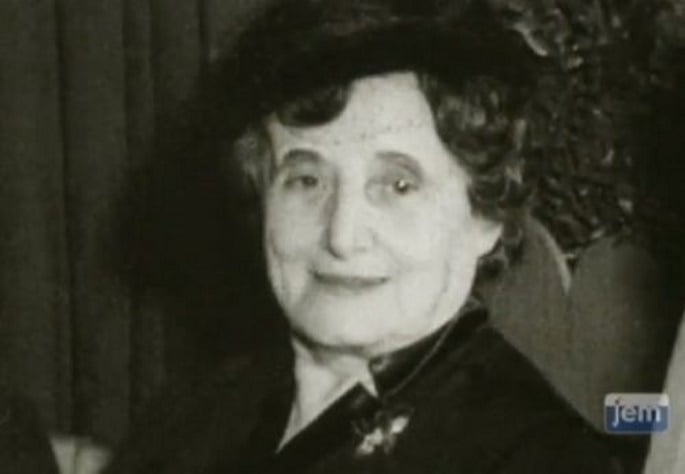
After this holy man’s passing, his wife, the Rebbetzin, withdrew into herself. She no longer dressed up for the holidays and tried to be among people less often.
Time passed, and a son was born to us. We invited Rebbetzin Chana to the bris. When she entered, every corner of our home seemed to brighten. Tears sparkled in the Rebbetzin’s eyes when the child was named: Levi Yitzchak.
***
I take pride in the characterization I received from the Rebbe’s father. During one farbrengen with R. Levi Yitzchak, he gave a verbal description of every Lubavitcher chassid living in Alma-Ata. There were scholars in Chassidus and Nigleh, activists, philanthropists, and many others with various virtues, each with their own personal merits. However, the last description was for me.
He said: “A chassidisher beindel iz Yeisef.” “Yeisef is a chassid to his bones.”
This characterization isn’t about being an outstanding scholar or the like. This is who he is, and that’s it.
Now let us escort the Rebbetzin, the Rebbe's mother, to Moscow, from where she will travel to her son, our Rebbe.

Alma-Ata to Moscow
I walk down Ninth Lane, where the Rebbe’s mother lived. I reach the small window behind which the Rebbetzin resides and knock gently. She approaches and opens the window. “Good day,” I greet her, “how do you feel?” Without waiting for her response, I continue: “Do you have any acquaintances or relatives in Moscow?” “Not really,” she says. “There’s a distant relative there, a teacher, but he’s far from our way of life. Why do you ask?”
“Here’s why: I’ve decided to help you reach Moscow!”
Rebbetzin Chana at this moment was very lonely, battered by life and devastated by her husband’s death. As surprising as it may be, she clung to my advice like a drowning person would to a straw. She did not argue or resist.
“Alright,” she said.
I didn’t just walk home, but rather flew, carried off by the thought I had in mind.
The first thing I do is tell Tsilya: “I decided to send Chana Meirovna to Moscow.”
I received a stern, incredulous reply: “Have you lost your mind? Sending an elderly, sick woman alone to Moscow? The train leaves Alma-Ata on Sunday and arrives in Moscow on Thursday.” But I stood firm in my decision, never wavering, and searched day and night for a way. Then G‑d sent me an opportunity.
In Alma-Ata lived a Leningrad family. Let’s introduce the elders first, followed by the younger members. Shmuel Yankev, the grandfather; Chana, the grandmother; Mottel, their son; Dveyra, their daughter-in-law; Rivochka, their granddaughter; and Borenka, their grandson.
We knew this family back in Leningrad, but in Alma-Ata we became close friends and lived near each other. Mottel and I worked together in the same department of the same factory. He was the department head, and I was a supervisor. The war ended, and the younger family members returned to Leningrad, but the grandparents remained in Alma-Ata.
The reason for temporarily keeping their elders in Alma-Ata ended, and the children invited them to rejoin them. One major obstacle to this was obtaining train tickets for the Alma-Ata—Moscow route. But I had a way to get them.
Shmuel Yankev came to me and said, “Yeshke, Mottel nemt unz in Leningrad, nem unz tzvei biletn” [“Mottel is bringing us to Leningrad, please get us two tickets.”] I thought about it, considered the situation, and replied, “Alright, but you’ll travel to Moscow with two Chanas.” The idea confused him. “Here’s the thing: you will travel to Moscow with your Chana and R. Levi Yitzchak’s Chana.”
Shmuel Yankev strongly objected. “What are you talking about! I’ll be happy if I can get my own Chana there healthy!”
“In that case,” I responded, “there are no tickets!”
Shmuel Yankev became agitated. “So you refuse to get tickets for the parents of your friend and colleague Mottel!!! I know where and from whom you get your tickets. I’ll go and get them myself.”
He turned away angrily and left, looking offended.
“Please, go ahead,” I called out after him.
I used to get the tickets from a close acquaintance of mine, a Kazakh named Dzhumat, who was the father of the head of the Supplies Department of the Academy of Sciences of the Kazakh Soviet Socialist Republic. Shmuel Yankev, who lived on the same street, had previously seen me entering Dzhumat’s courtyard, which contained two houses. One was traditionally Kazakh, with all the customs and rituals of the Kazakh nationality, and the other was built in a European style, where Dzhumat lived with his son.
Frisky German Shepherds roamed the yard, which no stranger could enter. And if someone greeted him in the street, Dzhumat wouldn’t reply.
Dzhumat’s dogs scared poor Shmuel Yankev off, and he came back to me, looking contrite.
“Tell me yourself,” he began, “can I really travel with two Chanas? If I’m traveling with my wife in a coupe with two lower berths, Chana will be on one, and I’ll be on the other. But with two Chanas, they will take the lower berths, and I’ll have to climb to the upper one. Can I even fit there?”
“Listen to me, R. Shmuel Yankev,” I responded. “Your wife and Rebbetzin Chana will take the lower berths in one coupe, and you’ll have the lower one in the next coupe. That’s how it will be until Moscow. Do you like this plan?”
“But that’s impossible to get,” he objected.
“Let me handle that,” I replied, “but do you agree?”
“If it’s like that, then I agree!”
“Then go home and start packing; you’re leaving on Sunday.”
I informed the Rebbe’s mother about her departure to Moscow on Sunday. She accepted it calmly, like a walk in the park: no excitement, no questions, she only asked me to help her pack her belongings. It wasn’t easy for me to get three lower berth tickets to Moscow, but sure enough, I soon had them in my pocket. That Thursday evening I came to Rebbetzin Chana to start helping pack her belongings and food.
By this time, the Rebbe was sending his mother parcels, both clothing and food. There was a lot to pack. I worked until midnight, packing, folding, tying things up. Chana Meirovna wanted to take everything with her; she did not want to leave behind so much as a thread or a piece of gefilte fish in the USSR.25 Motzei Shabbos came, and I resumed packing. By one o’clock in the morning, the last knot was tied. Rebbetzin Chana held up like a hero. She had no complaints about anything, and neither did she bother me with questions: How will the trip go … ? Who will see her off … ?
Sunday comes. Early in the morning, I am on a heavy-duty horse-drawn cart loaded with the Rebbe’s mother’s belongings. They start accepting and loading luggage two hours before the train departs. Rebbetzin Chana and the family arrive at the station by bus. Usually, the luggage is sent on a special cargo train, which means a long wait at the destination for the luggage to arrive. I managed to load all of their baggage into the luggage carriage attached to the main passenger train. I enter the passenger car, and Chana and Shmuel Yankev are sitting peacefully, chatting as if they’re going on a summer holiday. I notice there are twenty minutes left until departure, so I quickly head to the farm stand nearby.
I buy a basket of strawberries, return to the car, place it on the table by the window, hear the whistle, and quickly exit. Slowly but surely, the train departs … .
I learned the end of Rebbetzin Chana’s story decades later. My words, “You will yet live with your children,” came true.

The Last Duty
Morning. With grief on his face and anxiety in his soul, Meysha Chaim came to see me.26 R. Levi Yitzchak asked that no one who had not been in the water, meaning the mikvah, should touch him. This was the Rebbe’s father’s final request on earth.
At that time, there was no mikvah in Alma-Ata. “Let’s go to the quarry and immerse ourselves,” says Meysha Chaim to me.
Against the backdrop of Alma-Ata, the majestic Tian-Shan mountain range shimmers. On the edge of the city itself, there’s a deep quarry—its name speaking for itself about the people’s occupation there: penal labor.
A river rushes down from the mountains, known [in Kazakh] as an “aryk;” its waters rage and roar, carrying stones within. You immerse yourself in one spot, only to emerge in another.
We reached the aryk, and before I could gather my bearings, Meysha Chaim swiftly shed his clothes and plunged into the roaring water beside me. Moments later, I saw Meysha Chaim in the distance. Seeing the older person jump in without a second thought, I too took the risk. Thankfully, the water swept me to safety. We proceeded to the funeral in silence, having fulfilled our last duty.
The Monument
 Liberow, who served as a shochet and Jewish communal leader in Alma-Ata until his passing in 1982. - Luba Liberow")
I am writing this on February 7, 1985. At this point, I will tell the history of R. Levi Yitzchak’s matzeiva [tombstone], what it was like when it was first erected, and what it is like now. It should be noted that decades later, at the Rebbe’s instructions, the text on the tombstone was slightly modified.
***
There lived in Alma-Ata an elderly man named Meysha, “the Leningrader” they called him. His specialty was crafting matzeivos, carving text onto thick marble slabs.
Meysha the Leningrader was the one who carved the text on the tombstone of the Rebbe’s father, the Yekaterinoslaver Rav, R. Levi Yitzchak Schneerson, which amounted to the name of the person to whom it belonged.
Years passed; I spent six years in a prison camp. In 1956, I returned to Alma-Ata.
I am heading to the cemetery with Gilya.27
We approach the matzeiva of the Rebbe’s father, and I see the whole monument has tilted to the right, under it a gaping hole.
“R. Gilya,” I say, “look at what’s happening.”
“Yes,” Gilya replies, “it needs fixing.”
On our way back, a large, tall man is moving toward us, walking in a slovenly manner. He looks like he could be called a giant. The shovel on his shoulder makes him appear even larger. His face is intimidating, with a thick nose covered in blue veins, bulging eyes, and lips that don’t quite align. This massive figure mumbles something under his breath. I take a few steps towards him, and I’m already at his side. I calmly ask him: “Do you work at the cemetery?”
One word shoots out from this big man. “Yes!”
“Then come with me, take a look at what needs to be done.”
The three of us turn back towards the Rebbe’s father’s grave. He sobers up, straightens himself to his full height, and says clearly: “One hundred ... fifty ... rubles ... . I’ll put up rails, brick it up and plaster it. You’ll thank me.”
Today is Sunday, I say, will it be ready by next Sunday, at eleven in the morning?
Yes! he replies.
I put my hand in my pocket, and the money vanishes into the calloused fist of this big man.
We part peacefully. As soon as we’re out of earshot, Gilya bursts out at me: “Have you gone crazy? You gave that drunkard so much money—you’ll never see him again! You should’ve given him five rubles as a down payment, and then once he completes the job pay him the rest. I would’ve given you 75 rubles. Of course, he won’t do it, and I won’t give you a single kopek!”
The following Sunday, Gilya and I are again walking through the cemetery. We take one turn, then a second, and a third, and the Jewish section becomes visible. As we get closer, we see a man, his head sticking out above the fence. He looks at us with eyes that don’t contain a trace of alcohol. “It’s ready, take a look,” he says, “here are the rails,” pointing at them, “here’s the brickwork, here’s the plaster!”
“Thank you,” I say, offering my hand.
The matzeiva of the Rebbe’s father stands sturdy to this day.

Soldiers Carry Out Orders
Now let’s skip ahead a couple of decades, and we’ll write about the changes that were made.
American tourists, Lubavitcher chassidim, begin to visit Alma-Ata. They photograph R. Levi Yitzchak’s sacred burial place and send the photos to his son, our Rebbe.
One evening, Lozik Gorelik from Tashkent calls me out of the blue.28 He says that an instruction from the Rebbe has reached him to change the tombstone. Or rather, the stone slab containing the engraved text that is embedded in the monument.29 The text, he says, should remain the same, except for the last word, which should be removed.30 Lozik therefore asks me to measure precisely the rectangular board upon which the words are written, and to let him know its size, so that he can have a new one carved in Tashkent.
“Call me back tomorrow at the same time,” I tell him.
The next morning, armed with a tape measure, I head to the cemetery alone to measure the matzeiva carefully.
As I measured, I felt a heavy sense of discomfort and even guilt. True, I was there to measure the stone at the request of the Rebbe, the son of the man to whom this gravestone belongs and in whose name it was created, but who was I to be assigned such a daunting task? I recalled how, in a moment of intensity during a farbrengen, the Rebbe’s father, the Yekaterinoslaver Rav, R. Levi Yitzchak Schneerson, had become agitated. Here is his matzeiva ... the one which had stood there for decades, indicating to people: “Here lies buried the righteous tzaddik, R. Levi Yitzchak Schneerson.” And I am measuring it in order to shatter it, so that only fragments of the letters of this text remain …
But an order is an order, and a soldier must carry it out.
What had made the Rebbe’s father so upset during that farbrengen that I recalled?
Years earlier, the city council of Rostov-on-Don, the city where the Rebbe Rashab31 is buried, decided to demolish the old Jewish cemetery as the city needed the space. The city administration allowed the Rebbe Rashab’s tomb to be moved to the new Jewish cemetery.
The Rebbe Rashab’s son, the Rebbe Rayatz,32 entrusted R. Levi Yitzchok Schneerson of Yekaterinoslav with moving his father’s grave to the new Jewish cemetery. During that farbrengen, when R. Levi Yitzchak recalled the relocation of the Rebbe Rashab’s grave, he shuddered both in spirit and body.
He had overseen the relocation of the Rebbe Rashab’s grave, and here I was, tape measure in hand, at the Rebbe’s father’s tombstone, beginning the process of overseeing the replacement of its stone. So it should not be at all surprising that as I measured, I felt somehow heavy and even guilty.
That evening, Lozik Gorelik calls me and I give him the dimensions. Many months pass. The text is being engraved at Lozik’s house, with those involved regularly immersing themselves in the mikvah.33
Lozik calls and says that the tombstone is ready. They will bring it to my house the next day, at five in the evening, and I should arrange for a craftsman to install it. I find one based on a friend’s recommendation, being told that the craftsman is highly skilled, an expert in his field. By five in the evening, the craftsman should be waiting near his house; all the cement mixtures and tools will be ready when I pick him up.
This was a time when many Lubavitcher chassidim living in Tashkent were receiving permission to emigrate.
Almost everyone, before leaving the USSR, came to Alma-Ata to visit the Rebbe’s father. In the morning, they would come to me, go to the mikvah located in my house—which I maintained and warmed up for the visitors—and then proceed to the sacred resting place of the Rebbe’s father.34 On the days they visited, I would remain at home, expecting them. Usually, they notified me of their arrival a day in advance, and I would accompany them to the holy site. They would then return to my house with me, where we would eat and drink, as most of them had fasted before visiting R. Levi Yitzchak’s resting place. They would then gather their things and head to the airport, and I would often see them off.
The day on which we’d arranged to replace the slab on the tombstone felt like Yom Kippur to me. That day, for some reason, of all days, about 12 people unexpectedly arrived in Alma-Ata. In the morning, we organized a minyan at my house, prayed, and then headed to the cemetery in groups. Of course, they did not walk there together, so as not to draw undue attention to what was happening near my house.
The truth is that the neighbors saw visitors constantly coming and going from my house with suitcases. They knew.
The Visitors
 Branover, one of the many Refusenik Jews to visit R. Levi Yitzchak's burial place before receiving permission to leave the Soviet Union.")
That day, I was busy preparing to meet Lozik with the new slab. I was with the craftsman, checking if everything would be ready by five in the evening. I visited Gilya earlier, making sure he would be ready to go with us to the cemetery. By three o’clock, I returned home and learned that two more people had already arrived and left. They behaved strangely before leaving; one of them opened his briefcase, in which a jar of sour cream had spilled. They then took out bread, washed their hands, and began to dip the bread into the sour cream smudged throughout the briefcase. After eating, they left.
Now, who were these two? One was Der Kazaner — a physicist who lived in the city of Kazan and worked at the university. Mordechai (Mottel) Dubin, a former member of parliament in independent Latvia, had been exiled to Kuybishev, where the physicist’s in-laws lived.35 Dubin had a profound influence on the entire family, drawing their son-in-law to Judaism so much that he left his university job to study Torah.36
Who was the second one dipping bread into the sour cream spilled in the briefcase? It was a man in a tilted beret, Professor [Herman] Branover,37 a physicist specializing in energy, who is known to all Lubavitcher chassidim. He now works at the University of Be’er Sheva in Israel and is the author of many books on Judaism and the current state of Jewish religious life in the USSR.
By the way, it is now motzei Shabbos [Saturday evening,] November 9, 1985, and I am writing these pages in Stony Brook, Long Island, in the apartment of my youngest son, Levi Yitzchak. His wife is the daughter of the world-renowned physicist Lev Abramovich Vulis. Decades earlier, as a young physicist, Branover would travel from Riga to Leningrad to consult with Professor Vulis and often visited his home. My “mechutan,”38 Professor Vulis, is no longer alive, but his wife lives in the same house with our children. I write these details because I am still under impression of the Divine providence of it all, which I mentioned today in my speech earlier today at the synagogue located on the premises of Stony Brook University. I said: “We believers in G‑d believe in ‘hashgacha pratis’ [Divine providence in an individual’s life], and we live wherever G‑d wishes.” Vulis and Branover; my son and Vulis’s daughter; his wife; me—we are all interconnected.
Leningrad, Alma-Ata, Riga, who lived where, who lives where, it’s all “hashgacha pratis!” America!

The Operation
It is between five and seven in the evening. From the entrance of the cemetery to the holy site is relatively far. If compared with the territory of the “living,” it’s about three full-length streets. Four people, three Jews and one non-Jew, heavily burdened, slowly make their way to the sacred place. Who are they? Gilya, me, Lozik, and the craftsman. The craftsman and I are in the lead. We’re carrying cement mix, tools, fastenings, wire, rope and gloves. There is a sledgehammer in the craftsman’s hands, and a shovel in mine. About ten paces behind us, Gilya and Lozik, slightly hunched, are carrying the headstone’s centerpiece, the inscription carved into the marble slab. I hear a commotion behind me; Gilya is saying something loudly. I leave the craftsman with his load and approach them, asking, “What’s all the noise about?” Gilya replies, “We can’t allow a non-Jew to participate in the replacement of the headstone.”
“What should we do?” I ask Gilya.
“Well,” Gilya answers, “Take this,” pointing at the slab, “home with you, and let Lozik go to Tashkent and bring back a Jewish craftsman!”
“No,” I respond decisively. Gilya, becoming more passionate, says to me loudly: “Are you taking responsibility for a non-Jew’s participation in the replacement of the matzeiva?”
“Yes, I am!” I say, and turn to the craftsman, who didn’t understand what was happening. “Hurry,” I tell him. We nearly ran to the holy site. “Break it!” I commanded. The first strong blow with the sledgehammer sends marble shards flying in all directions, some carrying a letter, some, half or a quarter of a letter. My heart jolts at the sight. By the time Gilya and Lozik reach the sacred place, there is no going back; the replacement is inevitable, the old slab is shattered. With surprising speed, the old slab was completely removed, leaving a deep, empty square space. Some force guided us as I grabbed the right side, Lozik the left, and we brought the slab to the craftsman. “Pour,” I commanded him, and the thick cement slowly spread over the entire surface of the center of the matzeiva.
“Let’s proceed,” I say to Lozik. We begin inserting the slab into the cleared space, and it is almost swallowed up whole. We gasped. The first thing I say to Gilya is, “Well, now you see that we had to do it this way. Everything was so perfect, it didn’t even require reinforcement!”
We collected the fragments of the old text and buried them in the place where there had earlier been a pit. We talked, read tehillim, and left as if from a battlefield, exhausted. A few months later, instructions came from the Lubavitcher Rebbe to bury the fragments of the old text near the matzeiva.

Yankel’s Message
Yankel is an old acquaintance of mine. This is the same fellow we took into our family in Chernovtsy, for whom we used to leave a plate of mamaliga39 during those post-war years of hunger. I arranged for him to take my job after I was fired for private entrepreneurship—working on my own knitting machine in a cooperative’s workshop that didn’t have the funds for equipment. He’s the same one who set off on foot with an informant to Romania but ended up in a Chernovtsy prison, receiving the maximum sentence for treason, and was sent off to serve his time.40
Many years passed, and the “father” of the Soviet people is dead; he lies in Moscow now, next to Lenin, in the Mausoleum.41
Yankel is eventually freed from prison, and with G‑d’s blessing, lives in Tashkent, where he is the head of a family. His wife comes from a distinguished family, and they have three children. Whenever I visit my Chabad friends in Tashkent and stop by Yankel’s home, I see a real “veteran,” a dignified, and serious Chabad chassid. Everything is well; he has changed quite a bit, but his old, stubborn character remains.
As Jews begin to leave the USSR, Yankel submits his documents to the OVIR (Department of Visas and Registrations). He manages to cause a commotion over their “refusal” to allow him to leave the USSR, and earns the label of “Refusenik.” The head of the OVIR tells Yankel that as long as he, the head, is alive, Yankel will not leave the USSR. He keeps his word, and refusals continue to pile up for Yankel.
It is a dark Alma-Ata night. The silence is pierced by the ringing of a telephone. Tashkent is calling! Now, let’s take a moment to pause and consider one thought.
Belief and knowledge are different concepts; whether or not you believe is your choice. But not believing in what you know, in what you have seen with your very own eyes, is impossible: If you don’t believe at this point, then your sanity is questionable.
“Yes, yes, Alma-Ata, I’m listening! Tashkent, Yankel, good evening!” Yankele tells me that his children are ill. His wife is sick as well, and he asks me to go to the holy site to pray for the recovery of his family. He requests that I write down the names of his children and his wife.
I prepare myself and set off.
I read out the names, pray as required, and suddenly, to my surprise, I find myself loudly saying, “How long will you torment our Jewish son, Yankel? I beseech you, R. Levi Yitzchak, intercede with G‑d to release Yankel!”
Some time goes by, and I receive another phone call from Tashkent. Yankel is on the line; he asks me to come to Tashkent to say goodbye. They have been granted permission to leave. I immediately fly to Tashkent. Here’s what Yankele tells me: “I received a notice from the OVIR stating that at a commission meeting held on such-and-such date, it was decided to grant Yankel permission to leave.
We start to trace back the date of the meeting when permission was granted. It turns out that it was on the very day when I had asked the Rav to plead with G‑d for Yankele to receive permission to leave the USSR. As we say our goodbyes, Yankel hands me 50 rubles and says, “I’m giving this money towards the upkeep of the holy resting place of the Rebbe’s father.”
“When you get there,” I say to him, “visit the Rebbe and tell him everything that happened with your departure, explain it all in detail.”
Among Lubavitcher chassidim, it is in principle not customary to discuss their interactions with the Rebbe that are beyond the ordinary.
Yankel responds, “I won’t tell the Rebbe about this, and I advise you not to share it with anyone, either.”
“Alright,” I say, “I asked you to do it, but you can do as you wish.”
Those were our final words of farewell.
I went back to Alma-Ata, Yankel, eventually, to America.42
Months passed—I don’t remember exactly how many, as Yankel’s route wasn’t Tashkent—New York but rather Tashkent, Moscow, Vienna to Rome, where one can remain for many months.
One day, an American letter peeks out of our mailbox. I look at it—it is from Yankel. I was particularly pleased to read the part where he wrote: “As soon as I entered the Rebbe’s presence, I recounted everything in detail about my departure. When I finished, the Rebbe asked me to repeat it.”



Oh hashem there is so much suffering if only people read the Torah and the tanakh and prayed to the supreme architect of the universe ,we would be closer to you and our fellow man kind shalom