


Here’s something to think about the next time you put on your shoes: There are a host of Jewish practices and traditions related to footwear! From Biblical mitzvahs to kabbalistic conduct, shoes play a surprisingly significant role in Jewish life. Read on for 16 things Jews do with shoes.
1. Put on First, Tie Second
The Torah covers every aspect of life—even an action as mundane as putting on your shoes! Based on the halachic principle that the right side is more prestigious, the right shoe is put on first and removed last. If you’re a lefty, the order is reversed.
But here’s where it gets interesting: Once your shoes are on, the left shoelaces are tied first (and untied last). Why? Because tefillin are tied on the left hand, giving that side greater “tying prestige.”1
Read: Using the Right Side
2. Perform Chalitzah

This one’s been around since Biblical times. When a married man passes away without children, the Torah prescribes that his brother marry the widow—a union known as yibum. But what if the brother refuses? A ceremony called chalitzah must be performed. The key moment involves the widow removing a specially designed shoe from her brother-in-law’s foot.2
3. Wear Non-Leather Footwear Twice a Year
On Yom Kippur, the Torah instructs us to “afflict” ourselves as part of the day’s atonement.3 One of the five ways we fulfill this obligation is by not wearing leather footwear. On Tisha B’Av, we similarly avoid leather shoes as a sign of mourning over the destruction of the Holy Temple. Instead, people wear non-leather sandals, sneakers, or slippers—often simply called “Yom Kippur shoes” or “Tisha B’Av shoes” in many Jewish homes.
4. Make a Daily Blessing on Them
Every morning, Jews recite a series of blessings thanking G‑d for everyday gifts. One of these blessings is: “Blessed are You … Who has provided me with my every need.” Which specific need are we thanking G‑d for? Shoes, which allow us to go about our daily business!4 (This blessing is omitted on Yom Kippur and Tisha B’Av, when we don’t wear regular shoes.)
5. Kohanim Remove Them Before Giving Blessings
Here’s an interesting practice involving the Kohanim (members of the priestly clan). Before blessing the Jewish people on special occasions (a ceremony known as Birkat Kohanim), they remove their shoes. The reason? To avoid a scenario where a Kohen might lag behind to tie a torn shoelace and miss the blessing, causing onlookers to suspect he may not actually be a Kohen.5
Read: 14 Facts About Kohanim
6. Careful Congratulations
Your friend just bought a gorgeous new pair of shoes. How should you congratulate them? With standard clothing, a traditional Jewish blessing might be, “Wear it out and get a new one!” But with leather shoes (or other animal-based garments), some people avoid that language. Why? Because such phrasing emphasizes taking the life of another animal unnecessarily, and Jewish tradition teaches that “G‑d's mercy is upon all His creations.”6
(That being said, there is no halachic restriction on wearing leather—it’s just about how we express our good wishes!)
7. Mourners Place Earth Inside
During shivah (the seven-day mourning period), a mourner does not wear leather shoes. But in cases where a mourner absolutely must wear such footwear—say, when summoned by a government official—the mourner should place a bit of earth inside. This keeps them mindful of their state of mourning even while wearing regular shoes.7
8. Remove Them at Holy Sites
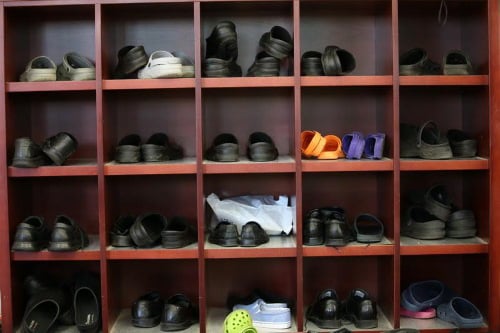
When the Holy Temple stood in Jerusalem, visitors were required to remove their leather footwear before entering.8 Many Jews have a similar custom today when visiting the Ohel (the Rebbe’s resting place) or the graves of other righteous leaders.
This custom has an ancient source: When Moses stood at the Burning Bush, G‑d told him to remove his shoes, “as the land upon which you are standing is sacred.”9 One reason given is that the earth was cursed following Adam’s sin, so we wear shoes to maintain a separation. But on blessed ground, no such separation is needed—we can connect directly with the holiness beneath our feet.10
9. Rinse Hands After Touching Them
Tradition tells us that an impure spirit rests on one’s shoes. That’s why we wash our hands after touching them.11
10. Grooms Untie Them Before the Wedding Ceremony
In some communities (such as Chabad), all knots and ties on the groom’s clothing—including his shoelaces—are undone before the wedding ceremony begins.12 Where does this custom come from? In days of old, it was said that sorcerers could cast spells on a new couple via the knots on their clothing.13 By undoing all knots, the couple starts their marriage free from any negative influences.14
11. Don’t Shine Them on the Day of a Trip
The medieval scholar Rabbi Yehuda HaChassid (“the Pious”) left a list of mystical practices in his last will and testament. One of them: Refrain from shining your shoes on the day you set out on a trip. The reason? Nobody really knows! In fact, Rabbi Schneur Zalman of Liadi, founder of Chabad chassidism, is said to have commented that one would need to compose a large work to explain just this single practice.15 Some mysteries remain … mysterious.
Read: Rabbi Yehuda HaChassid
12. Special Shoes for Shabbat

It's a mitzvah to honor Shabbat with special food and clothing. Many people also have a dedicated set of shoes just for this holy day, commonly referred to as “Shabbat shoes.” Some even polish them every Friday to honor the holy day.
13. Self-Sacrifice for Shoelaces
Here's a powerful historical note: Throughout Jewish history, when oppressive regimes tried to force Jews to abandon their religion, our sages taught that Jews should be willing to sacrifice their lives for even the smallest religious detail. The Talmud gives a striking example: If Jews were to wear differently colored shoelaces than their non-Jewish neighbors, they should even give up their lives rather than conform.16
14. Not Wearing Shoes of the Deceased
It is customary to avoid wearing the shoes of a deceased person, as this is associated with spiritual danger.17
15. Not Switching the Right Shoe With the Left
Until the early 19th century, there was no difference between the shoes worn on the right and left foot. Yet, according to an ancient tradition, wearing the shoe you designated for your left foot on the right foot (and vice versa) should be avoided. Why? It's said that this mix-up can increase forgetfulness and decrease one’s livelihood.18
16. Running With Them to Do Mitzvahs!
But here’s the most important thing you can do with shoes: Use them to do more mitzvahs! So lace up, step out, spread some light, and make the world a better place—one mitzvah at a time!
Listen: Running to Do a Mitzvah


Join the Discussion