CARRIED ON HIS WINGS
ב"ה
Icon
Candle Lighting Times for
Pacific Palisades:
Friday, Sep. 18
6:38 pm
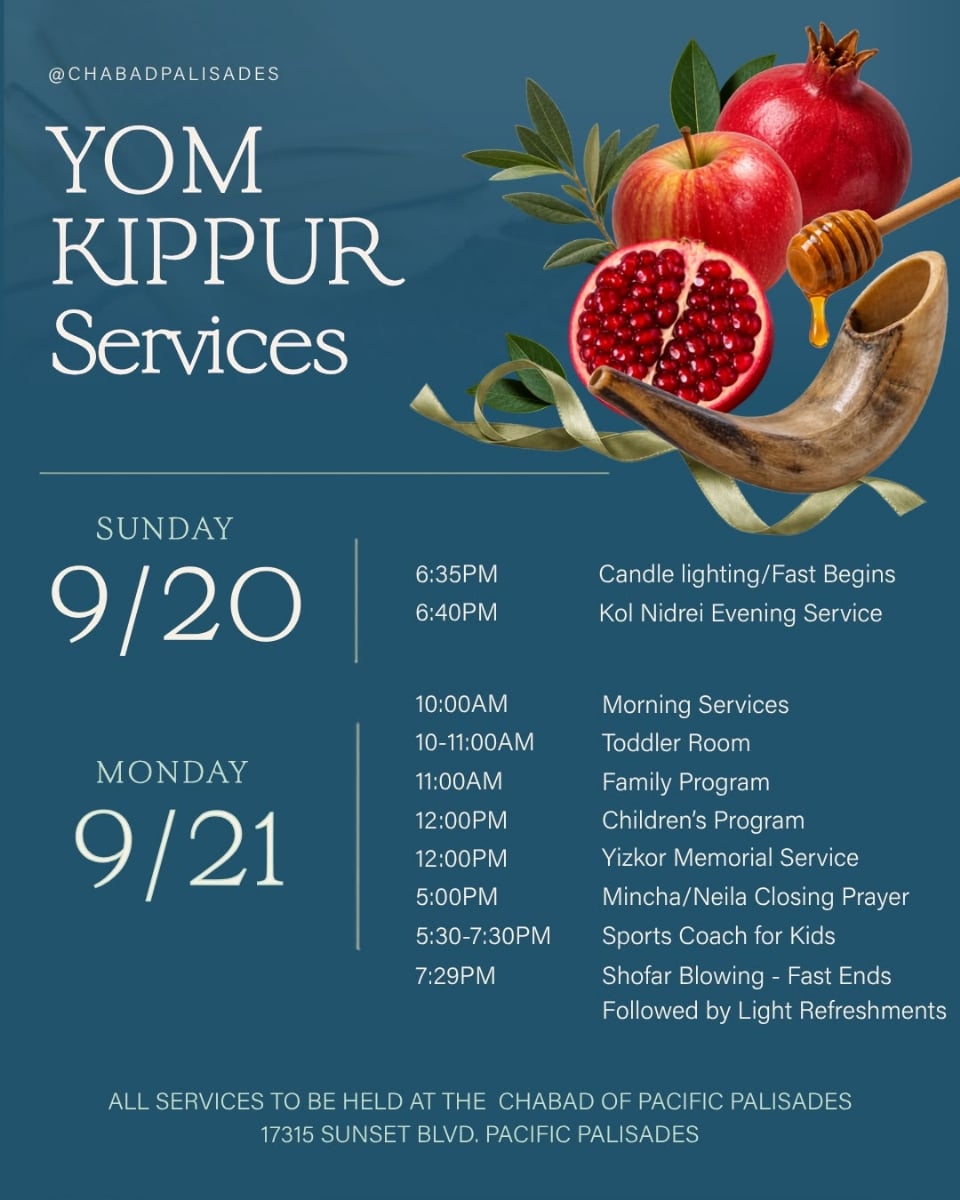
Sunday, Sep. 20
6:35 pm

Message from the Rabbi

Dear Friend,

In Haazinu (this week’s Torah reading) the Torah gives us a remarkable image of G-d’s relationship with His people:

“Like an eagle awakening its nest… spreading its wings, taking them, carrying them upon its pinions.”

Rashi explains that the eagle is different from other birds. Rather than carrying its young beneath its feet, it carries them above its wings, saying, in effect, Better that the danger reach me than reach my children.

That is an extraordinary image to carry with us into Yom Kippur.

We often approach Yom Kippur thinking primarily about judgment, What did I do this year? Where did I fail? What must I repair?

All of that matters. But before the judgment stands a relationship.

We are G-d’s children.

Chassidic wisdom teaches that Yom Kippur reveals this bond at its deepest level, a connection that our mistakes can obscure, but can never destroy.

Perhaps that is why Yom Kippur can be both the most serious and the most uplifting day of the year. We confront ourselves honestly, yet we do so knowing that we are not standing alone.

We are being carried.

May we enter Yom Kippur with sincerity and confidence, and emerge renewed, forgiven, and ready to soar higher in the year ahead.

Shabbat Shalom,
Rabbi Zushe Cunin

Shabbat Schedule:

Shabbat, September 19
Morning Service: 10:00am
Followed by Kiddush & Refreshments

Shabbat Ends 7:32pm

Sunday, September 20
Shachris: 8:30am

All services take place at Chabad Palisades 17315 Sunset Blvd.

Recent Photos

This Week @ www.ChabadPalisades.com

  
By the Numbers
15 Historical Events That Happened on Yom Kippur
Quite a number of things happened on Yom Kippur.
  
Your Questions
Can I Use (or Reuse) a Yahrzeit Candle for Something Else?
Is it considered a candle made specifically for the departed?
  
Freeman Files
Jews Don't Repent
Thirteen essays and stories that explore the what, why and how of of the most powerful force known to man--the power of self-transformation
  
Quiz
Take the Yom Kippur Who Am I Quiz
Test your knowledge of the characters of Yom Kippur.

Parshah in a Nutshell


Parshat Ha'Azinu

The name of the Parshah, "Haazinu," means "Listen" and it is found in Deuteronomy 32:1.

The greater part of the Torah reading of Haazinu (“Listen In”) consists of a 70-line “song” delivered by Moses to the people of Israel on the last day of his earthly life.

Calling heaven and earth as witnesses, Moses exhorts the people, “Remember the days of old / Consider the years of many generations / Ask your father, and he will recount it to you / Your elders, and they will tell you” how G‑d “found them in a desert land,” made them a people, chose them as His own, and bequeathed them a bountiful land. The song also warns against the pitfalls of plenty—“Yeshurun grew fat and kicked / You have grown fat, thick and rotund / He forsook G‑d who made him / And spurned the Rock of his salvation”—and the terrible calamities that would result, which Moses describes as G‑d “hiding His face.” Yet in the end, he promises, G‑d will avenge the blood of His servants, and be reconciled with His people and land.

The Parshah concludes with G‑d’s instruction to Moses to ascend the summit of Mount Nebo, from which he will behold the Promised Land before dying on the mountain. “For you shall see the land opposite you; but you shall not go there, into the land which I give to the children of Israel.”

Learn: Haazinu Rashi Studies
Browse: Haazinu Parshah Columnists
Prep: Devar Torah Q&A for Haazinu 
Read: Haftarah in a Nutshell
Play: Haazinu Parshah Quiz

 

Today's Quote

As in water face answers to face, so is the heart of a man to a man
— Proverbs 27:19

Chabad World News

  
Holiday Watch
A Bereaved Son’s Greatest Regret (and Gift)
  
North America
At Wilfred Laurier University, Mezuzah Vandalism Meets Its Waterloo
  
Europe
Denmark’s Mainland Gets High Holiday Services—and First Jewish Center in Decades
  
Holiday Watch
My Father’s Machzor
In 1951 my father, Rabbi Moshe Greenberg, was twenty years old and a prisoner in a Soviet labor camp in Siberia. That Yom Kippur, he faithfully prayed all the day’s prayers. All, that is, except for Kol Nidrei.