Revealing Our Inner Strength and Purpose
|
|
|
|
|
|
This Week at Chabad of Pacific Palisades
|
|

|
|
|
|
|
|
|

|
Message from the Rabbi
|
|
|
|
|
|
Dear Friends,
In this week’s Parsha, Vayishlach, we read about Jacob wrestling with an angel before reuniting with Esau. After the struggle, the angel blesses him with the name “Israel,” saying, “For you have struggled with G-d and with men, and you have prevailed.” This name change reflects the essence of our identity: perseverance in the face of challenges and the ability to emerge stronger.
“Jacob,” derived from eikev (heel), symbolizes the struggle of navigating life’s hardships and refining the material world. “Israel,” meaning “to prevail,” reflects the triumph that comes from revealing inner strength and purpose. Together, they represent
the duality of life: grappling with challenges while rising to a higher state of connection and fulfillment.
This transformation is not just personal—it is the story of the Jewish people throughout history and especially relevant today. Time and again, we are thrust into battles, whether spiritual, moral, or physical, that seem beyond our control. Yet, we consistently
emerge victorious, as Bnei Yisrael, revealing an unshakable resilience that defies logic. What appears as mere
circumstance is ultimately a process of refinement, pushing us to uncover deeper strengths and rise to our mission.
The name “Israel” reminds us that struggle is not a sign of failure but part of our purpose. Each challenge, whether personal or communal, is an opportunity to reveal the power within and transform adversity into triumph. In these moments, we fulfill the legacy of Jacob becoming Israel—overcoming every obstacle and emerging stronger, with the faith and confidence to shape the world for the better.
Looking forward to celebrating with you next week Thursday, December 19th at 5pm at our Pre-Chanukah Celebration at Palisades Village!
RSVP here and receive a beanie at the event while supplies last!
Shabbat Shalom,
Rabbi Zushe Cunin
|
|
|
|
|
|
|
|

|
Service Times
|
Friday Kabbalat Shabbat Chabad
4:45pm
Shabbat Morning Torah Study Class
9:00am
Shabbat Day Services
10:00am
Kiddush and Refreshments
12:30pm
|
|
|
|
|
|
|
|
Featured Events
|




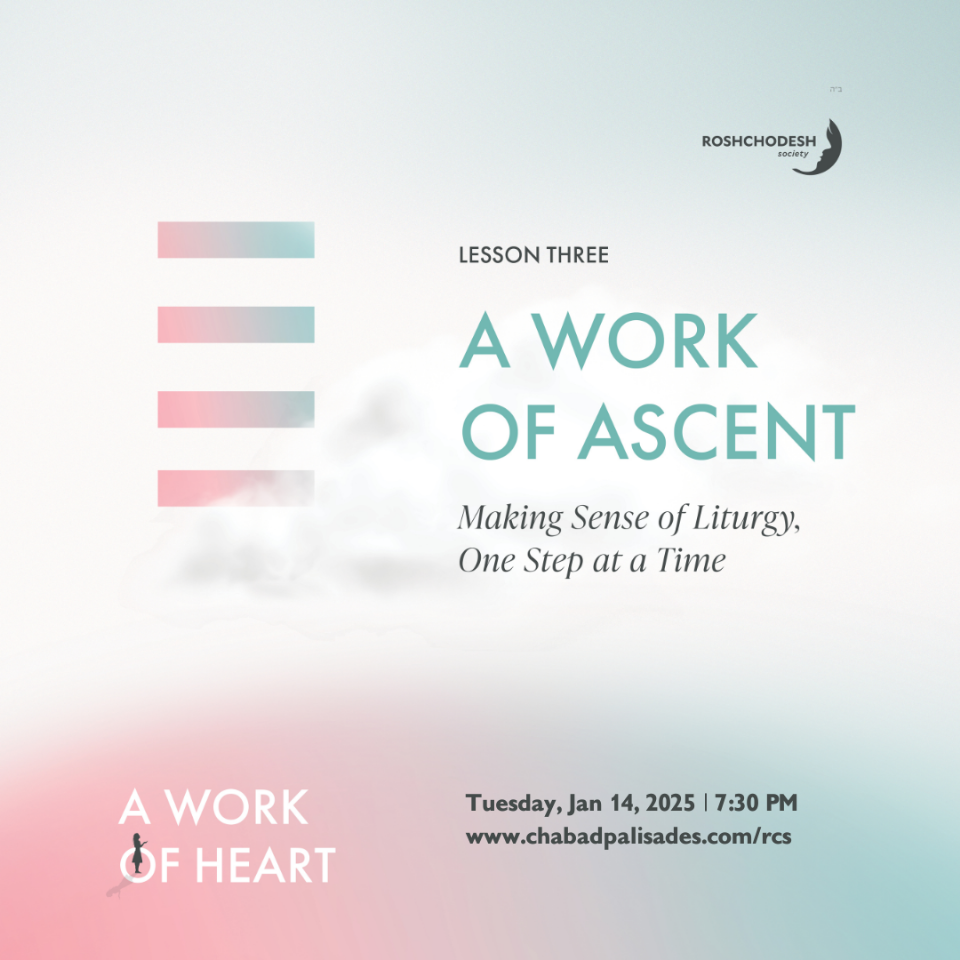
Weekly Tanya Class with Rabbi Shimon
Sundays 8:00-8:30am at Chabad
Practical Tanya with Rabbi Zushe
Wednesdays - Message Rabbi Zushe for details.
Parsha Torah Study
Shabbat Morning 9:00am at Chabad
|
|
|
|
|
|

|
Recent Photos
|
|
|
|
|
|
Recent Photos (new)
|
|

|
Upcoming Events
|
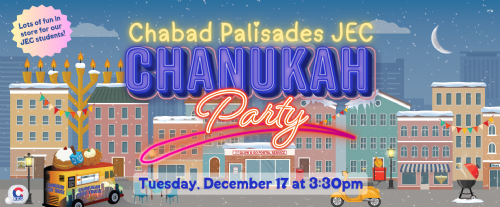
JEC
Tuesday,
Dec. 17, 2024 - 3:30 pm - 5:30 pm JEC
Tuesday,
Dec. 24, 2024 - 3:30 pm - 5:30 pm |
|
|
|
|
|
|
|

|
Donate
|
Join in and become a partner in the work we do!
|
|
|
|
|
|

|
Parshah in a Nutshell
|
Parshat Vayishlach
The name of the Parshah, "Vayishlach," means "And he sent" and it is found in Genesis 32:4.
Jacob returns to
the Holy Land after a 20-year stay in Charan, and sends angel-emissaries to
Esau in hope of a reconciliation, but his messengers report that
his brother is on the warpath with 400 armed men. Jacob
prepares for
war,
prays, and sends Esau a large gift (consisting of hundreds of heads of livestock) to appease him.
That night, Jacob ferries his family and possessions across the Jabbok River; he, however, remains behind and encounters the angel that embodies the spirit of Esau,
with whom he wrestles until daybreak. Jacob
suffers a dislocated hip but vanquishes the supernal creature,
who bestows on him the name Israel, which means “he who prevails over the divine.”
Jacob and Esau meet,
embrace and kiss, but part ways. Jacob purchases a plot of land near Shechem, whose crown prince—also called Shechem—
abducts and rapes Jacob’s daughter
Dinah. Dinah’s brothers
Simeon and
Levi avenge the deed by
killing all male inhabitants of the city, after rendering them vulnerable by convincing them to
circumcise themselves.
Jacob journeys on.
Rachel dies while giving birth to her second son,
Benjamin, and is buried in
a roadside grave near Bethlehem. Reuben interferes with his father’s marital life. Jacob arrives in
Hebron, to his father
Isaac, who later dies at age 180. (Rebecca has passed away before Jacob’s arrival.)
Our Parshah concludes with a detailed account of Esau’s wives, children and grandchildren; the family histories of the people of Seir, among whom Esau settled; and a list of the eight kings who ruled Edom, the land of Esau’s and Seir’s descendants.
Learn:
Vayishlach in Depth
Browse:
Vayishlach Parshah Columnists
Prep:
Devar Torah Q&A for Vayishlach
Read:
Haftarah in a Nutshell
Play:
Vayishlach Parshah Quiz
|
| |
|
|
|
|
|
|

|
Today's Quote
|
| If I am I because I am I, and you are you because you are you, then I am I and you are you. But if I am I because you are you and you are you because I am I, then I am not I and you are not you! — Chassidic master Rabbi Mendel of Kotzk |
|
|
|
|
|
|

|
Chabad World News
|
|
|
|
|
|
|
|
|