Embracing Our Path with Confidence and Joy!
|
|
|
|
|
|
This Week at Chabad of Pacific Palisades
|
|

|
Friday, Sep. 27 |
6:25 pm |
|
Wednesday, Oct. 2 |
6:18 pm |
|
Thursday, Oct. 3 |
7:12 pm |
|
Friday, Oct. 4 |
6:15 pm | |
|
|
|
|
|
|
|

|
Message from the Rabbi
|
|
|
|
|
|
This week we read two Torah portions, the first is Nitzavim, translated as standing. The second is Vayelech, translated as walking forward. These portions are often read together and bring with them a joint message about how we, G-d’s people, are meant to move through this world..
G-d is a solid anchor, He is eternal and unchanging. Within G-d’s reality, there is only one truth, the truth of the Torah, there is no doubt, no lack, no pain, no suffering. We are encouraged to ‘stand together today’ within G- ’s solidity. The way we access that channel of reality is through following the teachings and commandments of G-d’s Torah. Some question why the Torah is so detailed
in its commandments, why it appears so complex at times. The reason is that Torah is the exact recipe that G-d, in His infinite knowledge, gave us for reaching a point of connection with Him, a connection with the Eternal. We may believe that we know better, that when something appears illogical, there may be a better way to perform the commandment. However we then limit ourselves to our human interpretation of the Divine, we fall short of reaching
the point of Nitzavim, standing with G- d, and therefore we limit the flow of Divine blessings that elevate us out of our painful and mundane struggles..
When we find our anchor and stand firmly with G-d, united as a people, united with our Creator, we can enter the stage of Vayelech, walking with G-d. Imagine the different experience of entering our day, our workspace, our home, our reality in a grounded manner. Imbued with a sense of confidence in our life choices. Feeling supported and connected to the Eternal reality of G-d’s vision
for our existence. The steps we take through life become more meaningful, more centered; more G-d oriented. The worries that plague us around finances, health and relationships fade as we hold ourselves in a place of faith, as we feel the fountainhead of G-d’s blessing pouring down upon us constantly.
May we be blessed to enrich our relationships with G-d through His Torah and commandments, and walk through the days of our lives with joy, meaning, confidence and faith.
Shabbat Shalom,
Rabbi Zushe Cunin
|
|
|
|
|
|
|
|

|
Service Times
|
Kabbalat Shabbat at Chabad
6:30pm
Shabbat Morning Torah Study Class
9:00am
Shabbat Day Services
10:00am
Kiddush and Refreshments
12:30pm
|
|
|
|
|
|

|
Featured Event
|
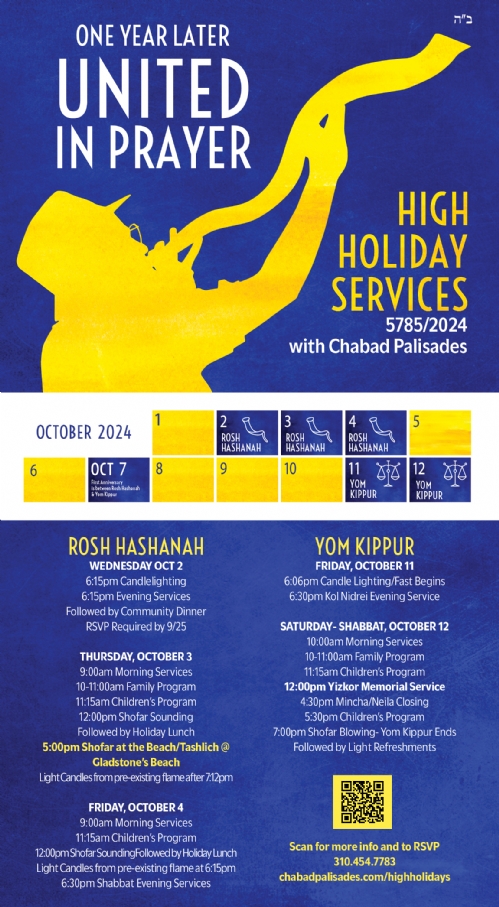


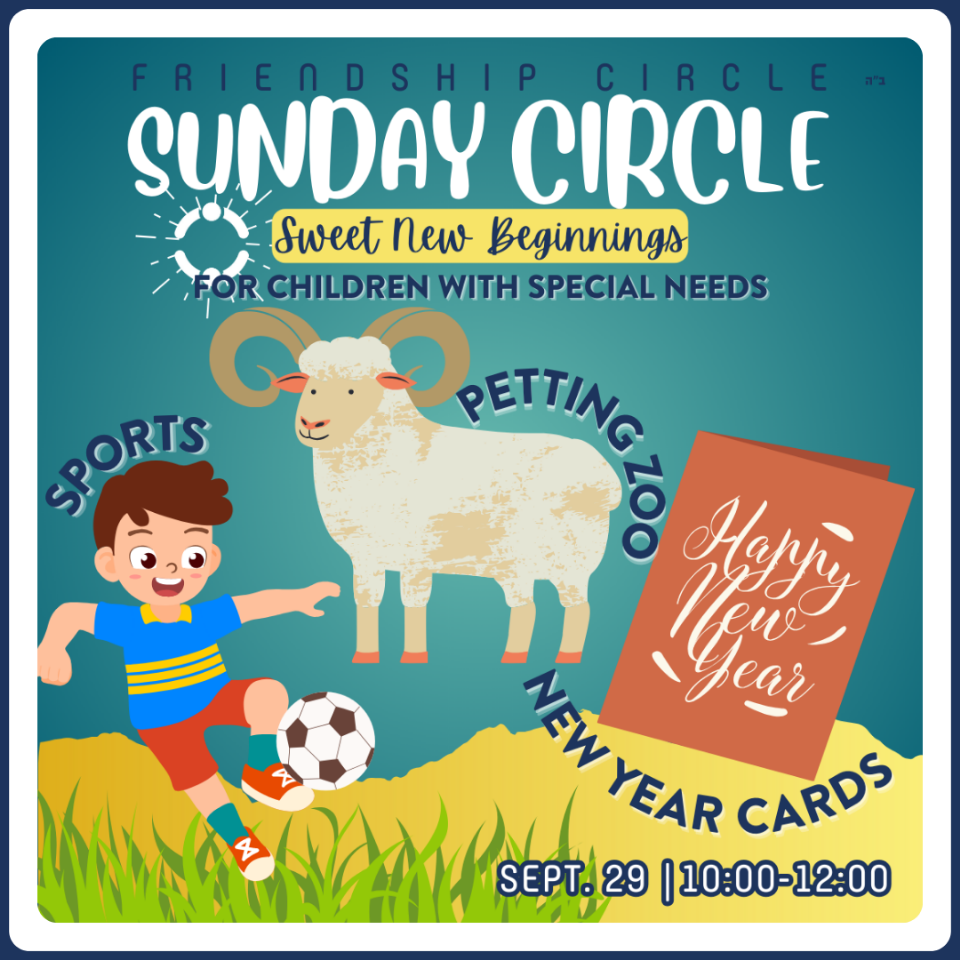


Weekly Tanya Class with Rabbi Shimon
Sundays 8:00-8:30am at Chabad
Practical Tanya with Rabbi Zushe
Mondays 1:30-2:30pm at Chabad
Parsha Torah Study
Shabbat Morning 9:00am at Chabad
|
|
|
|
|
|

|
Recent Photos
|
|
|
|
|
|
|
|

|
Upcoming Events
|
JEC
Tuesday,
Oct. 8, 2024 - 3:30 pm - 5:30 pm JEC
Tuesday,
Oct. 15, 2024 - 3:30 pm - 5:30 pm |
|
|
|
|
|
|
|

|
Donate
|
Join in and become a partner in the work we do!
|
|
|
|
|
|

|
This Week @ www.ChabadPalisades.com
|
|
|
|
|
|
|
|

|
Parshah in a Nutshell
|
Parshat Nitzavim-Vayelech
The name of the Parshah, "Nitzavim," means "Standing," and it is found in Deuteronomy 29:9. The name of the Parshah, "Vayelech," means "And [Moses] went," and it is found in Deuteronomy 31:1.
The Parshah of Nitzavim includes some of the most fundamental principles of
the Jewish faith:
The
unity of Israel: “You stand today, all of you, before the L‑rd your G‑d: your
heads, your
tribes, your
elders, your
officers, and
every Israelite man; your
young ones, your
wives, the
stranger in your gate; from your
wood-hewer to your
water-drawer.”
The
future redemption: Moses warns of the exile and
desolation of the Land that will result if Israel abandons G‑d’s laws, but then he prophesies that in the end, “You will return to the L‑rd your G‑d . . . If your outcasts shall be at the ends of the heavens, from there will the L‑rd your G‑d gather you . . . and bring you into the Land which your fathers have possessed.”
The
practicality of Torah: “For the mitzvah which I command you this day, it is not beyond you, nor is it remote from you. It is
not in heaven . . . It is not across the sea . . . Rather, it is
very close to you, in your
mouth, in your
heart, that you may
do it.”
Freedom of choice: “I have set before you life and goodness, and death and evil: in that I command you this day to love G‑d, to walk in His ways and to keep His commandments . . . Life and death I have set before you, blessing and curse. And you shall choose
life.”
The Parshah of Vayelech (“
and he went”) recounts the events of Moses’ last day of earthly life. “I am one hundred and twenty years old
today,” he says to the people, “and
I can no longer go forth and come in.” He transfers the leadership to Joshua, and writes (or concludes writing) the Torah in a scroll which he entrusts to the Levites for safekeeping
in the Ark of the Covenant.
The mitzvah of Hakhel (“
gather”) is given: every seven years, during the festival of Sukkot of the first year of the
shemittah cycle, the entire people of Israel—men, women and children—should gather at the Holy Temple in Jerusalem, where the
king should read to them from the Torah.
Vayelech concludes with the prediction that the people of Israel will turn away from their covenant with G‑d, causing Him to
hide His face from them, but also with the promise that the words of the Torah “
shall not be forgotten out of the mouths of their
descendants.”
Learn:
Nitzavim-Vayelech in Depth
Browse:
Nitzavim-Vayelech Parshah Columnists
Prep:
Devar Torah Q&A for Nitzavim-Vayelech
Read:
Haftarah in a Nutshell
Play:
Nitzavim-Vayelech Parshah Quiz
|
| |
|
|
|
|
|
|

|
Today's Quote
|
| Ascetism leads to purity, purity leads to holiness, holiness leads to humility, humility leads to fear of sin, fear of sin leads to saintliness, saintliness leads to the [possession of] the holy spirit, and the holy spirit leads to eternal life — Talmud, Avodah Zarah 20b |
|
|
|
|
|
|

|
Chabad World News
|
|
|
|
|
|
|
|
|