The Good, the Bad and the Good in the Bad
ב״ה

 
This Week at Chabad of Pacific Palisades
Candle Lighting
Candle Lighting Times for
Pacific Palisades:
Friday, Aug. 30
7:04 pm
Torah Portion: Re'eh
 
Chabad of Pacific PalisadesEmail: [email protected]Phone: 310-454-7783www.ChabadPalisades.com
 
 
Rabbi's Message
Message from the Rabbi
 
 
Dear Friends,

The Torah portion for this week begins with a fundamental principle in Judaism and a pillar of the Torah, that of Free Choice, the freedom of each person to choose between good and bad.

"See, I give you today a blessing and a curse” (Deut. 11:26).

Freedom of choice has been granted to every person: if he desires to turn toward a good path and be righteous, the ability to do so is in his hands; and if he desires to turn toward an evil path and be wicked, the ability to do so is in his hands.

The word for “curse” in the Aramaic translation by the great Talmudic sage Rabbi Yonatan ben Uziel is “chilufa,” which means “exchange” and “transmutation,” implying that “the curse” is something which devolves from the blessing and is thus an alternate form of the same essence. 

Our sages of the Talmud teach us that “No evil descends from Heaven.” Of course from a theological stand point, G-d is the Creator of all things which must include evil. So how can we understand the statement of the sages?

Rabbi Yonatan hints to the solution. A curse (evil), from a divine perspective is a transmutation of a blessing. Meaning, the evil itself is perceived by us as negative and can be very painful but its origin is from G-d and has a positive purpose and at its core it is good, since G-d Himself is all good. The Torah tells us “See, I have given you…a curse.” G-d encourages us to elevate our world view and see how everything that happens to us is for
the good and has its origin within the divine. I know, this is a tall measure and may seem far from our spiritual reach, however, the fact that G-d tells us to “see” it, proves that it is within our grasp to lift ourselves up and perceive with our human senses that G-d is with us and intends for our ultimate good, even when it is not obvious.

Shabbat Shalom,
Rabbi Zushe Cunin


Service Times
Service Times

Kabbalat Shabbat at Chabad
6:30pm

Shabbat Morning Torah Study Class
9:00am

Shabbat Day Services
10:00am

Kiddush and Refreshments
12:30pm


Featured Event
Featured Event

Weekly Tanya Class with Rabbi Shimon
Sundays 8:00-8:30am at Chabad

Practical Tanya with Rabbi Zushe
Mondays 1:30-2:30pm at Chabad

Parsha Torah Study
Shabbat Morning 9:00am at Chabad


Upcoming Events
Upcoming Events
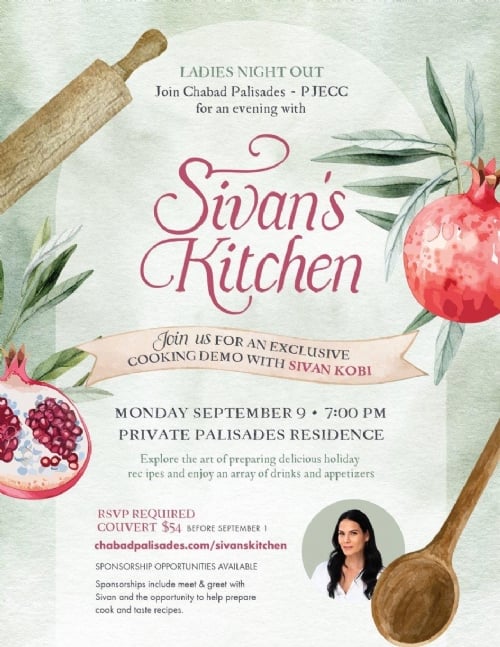
Sivan's Kitchen
Monday, Sep. 9, 2024 - 7:00 pm
More Info »
1st Day of JEC!
Tuesday, Sep. 17, 2024 - 3:30 pm
 
 
Donate
Donate

Join in and become a partner in the work we do!


This Week @
This Week @ www.ChabadPalisades.com
  
By the Numbers
14 Facts You Should Know About Kabbalah
Kabbalah is Jewish mysticism, an ancient tradition of Divine wisdom.
  
Your Questions
What You Need to Know about Making Havdalah Without Supplies
Find out if and how you can carry out this ritual in a pinch.
  
Letters of Light
What Can You Learn From the Letter Dalet?
  
Ordinary People; Extraordinary Stories
The Inner and Vulnerable World of a Public Speaker
Perhaps the best-known speaker in the Jewish world today, Rabbi YY Jacobson grew up to Russian immigrants in Brooklyn. Learn about his personal challenges, disappointments and victories.
 
 
Parshah
Parshah in a Nutshell

Parshat Re'eh

The name of the Parshah, "Re'eh," means "See," and it is found in Deuteronomy 11:26.

“See,” says Moses to the people of Israel, “I place before you today a blessing and a curse”—the blessing that will come when they fulfill G‑d’s commandments, and the curse if they abandon them. These should be proclaimed on Mount Gerizim and Mount Ebal when the people cross over into the Holy Land.

A Temple should be established in "the place that G‑d will choose to make dwell His name there,” where the people should bring their sacrifices to Him; it is forbidden to make offerings to G‑d in any other place. It is permitted to slaughter animals elsewhere, not as a sacrifice but to eat their meat; the blood (which in the Temple is poured upon the altar), however, may not be eaten.

A false prophet, or one who entices others to worship idols, should be put to death; an idolatrous city must be destroyed. The identifying signs for kosher animals and fish, and the list of non-kosher birds (first given in Leviticus 11), are repeated.

A tenth of all produce is to be eaten in Jerusalem, or else exchanged for money with which food is purchased and eaten there. In certain years this tithe is given to the poor instead. Firstborn cattle and sheep are to be offered in the Temple, and their meat eaten by the kohanim (priests).

The mitzvah of charity obligates a Jew to aid a needy fellow with a gift or loan. On the Sabbatical year (occurring every seventh year), all loans are to be forgiven. All indentured servants are to be set free after six years of service.

Our Parshah concludes with the laws of the three pilgrimage festivals— Passover, Shavuot and Sukkot—when all should go to “see and be seen” before G‑d in the Holy Temple.

Learn: Re'eh in Depth
Browse: Re'eh Parshah Columnists
Prep: Devar Torah Q&A for Re'eh
Read: Haftarah in a Nutshell
Play: Re'eh Parshah Quiz


Today's Quote
Today's Quote
Fear not a sudden terror, nor the ruin of the wicked when it comes. [They may] take counsel together, and it shall come to naught; speak words, and it shall not stand; for G-d is with us.
— Proverbs 3:25; Isaiah 8:10


Chabad World News
Chabad World News