The Rebbe’s Advice on Falling – and Getting Up
ב״ה

 
This Week at Chabad of Pacific Palisades
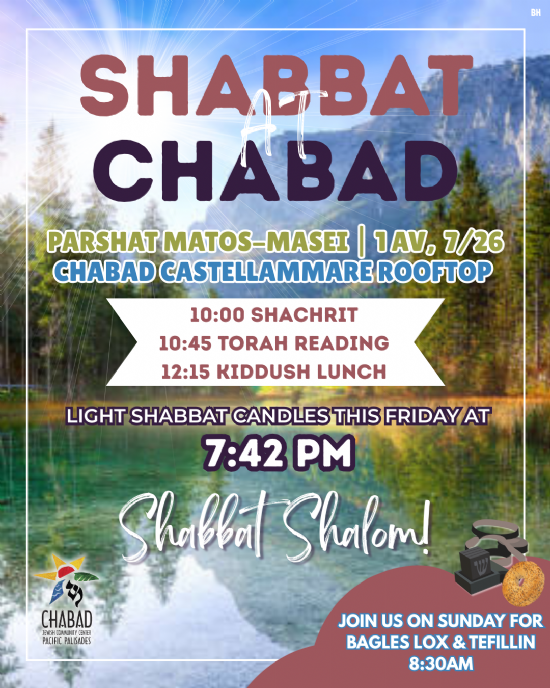
Candle Lighting
Candle Lighting Times for
Pacific Palisades:
Friday, Jul. 25
7:42 pm
Torah Portion: Matot-Massei
 

Chabad of Pacific PalisadesEmail: [email protected]Phone: 310-454-7783www.ChabadPalisades.com


Rabbi's Message
Message from the Rabbi


Dear Friends,

In this week’s double Torah portion, Matot and Masei, the Torah recounts the journeys of the Children of Israel through the wilderness: “These are the journeys of the children of Israel…” (Bamidbar 33:1). On the surface, it’s a historical list. But the Baal Shem Tov teaches that these 42 journeys aren’t only about the past, they mirror the spiritual journeys of every Jew throughout life. Every step, every detour, even the regressions, are part of a Divinely orchestrated path toward growth and purpose.

But how can we believe that the wrong turns in our lives are also “journeys” toward G-d?

The Alter Rebbe once told a Chassid who had fallen into spiritual despair: “Even a fall can be a step forward if you know how to fall correctly.” The Rebbe explained that when a person stumbles, the very pain of the fall can ignite a deeper yearning and bring one closer to to G-d than before. The key is not to get stuck in guilt, but to keep moving from Matos (firm convictions) to Masei (movement and journey).

Each station in the wilderness had its challenges; thirst, hunger, snakes, rebellion. Yet each one was necessary. Without them, they couldn’t enter the Land.

So too with us.

This Shabbat, as we read about the 42 journeys, reflect: what station are you at? What is your next step? Don’t be afraid of the detours. They may be leading you somewhere holier than you imagined.

May we merit to complete our personal journeys with clarity, strength, and joy,

Shabbat Shalom,
Rabbi Zushe Cunin


Service Times
Schedule

Shabbat, July 26
Shabbat Morning Services 10:00 AM
Followed by Kiddush Lunch Sponsored by the Tishbi Family in honor of Eliyahu's father's Yahrtzeit

Sunday, July 27
Morning Services 8:30 AM

All services take place at Chabad Castellammare
Please text Rebbetzin Zisi at (310) 628-4446 with any questions.


Service Times
Upcoming Events
 
 
Recent Photos
Recent Photos
 
Recent Photos (new)


Donate
Donate

Join in and become a partner in the work we do!


This Week @
This Week @ www.ChabadPalisades.com
  
By the Numbers
14 Facts About the Forgotten Jews of Afghanistan
Afghanistan today hardly seems a place for a Jew to call home, yet for hundreds of years it hosted a large, flourishing Jewish community.
  
Your Questions
Who Are the 36 Hidden Tzadikim?
  
New Course
New Course: The Holy Temple
What if humanity once had the ultimate user's manual for spiritual connection - and we lost it? The Holy Temple wasn't just architecture; it was a step-by-step guide to experiencing the divine, written in stone and ritual.
  
Podcasts
We Chose Judaism in Rural Montana
Gavriel and his late wife's Bible studies led them to embrace Judaism, which entailed driving 10 hours just to get kosher meat!
 
 
Parshah
Parshah in a Nutshell

Parshat Matot-Massei

The name of the Parshah, “Matot,” means “Tribes,” and it is found in Numbers 30:2. The name of the Parshah, “Masei,” means “Journeys,” and it is found in Numbers 33:1.

Moses conveys the laws governing the annulment of vows to the heads of the tribes of Israel. War is waged against Midian for their role in plotting the moral destruction of Israel, and the Torah gives a detailed account of the war spoils and how they were allocated amongst the people, the warriors, the Levites and the high priest.

The tribes of Reuben and Gad (later joined by half of the tribe of Manasseh) ask for the lands east of the Jordan as their portion in the Promised Land, these being prime pastureland for their cattle. Moses is initially angered by the request, but subsequently agrees on the condition that they first join, and lead, in Israel’s conquest of the lands west of the Jordan.

The forty-two journeys and encampments of Israel are listed, from the Exodus to their encampment on the plains of Moab across the river from the land of Canaan. The boundaries of the Promised Land are given, and cities of refuge are designated as havens and places of exile for inadvertent murderers. The daughters of Tzelafchad marry within their own tribe of Manasseh, so that the estate which they inherit from their father should not pass to the province of another tribe.

Learn: Matot-Masei in Depth
Browse: Matot-Masei Parshah Columnists
Prep: Devar Torah Q&A for Matot-Masei
Read: Haftarah in a Nutshell
Play: Matot-Masei Parshah Quiz



Today's Quote
Today's Quote
For this mitzvah which I command you this day, it is not hidden from you, neither is it far off. It is not in heaven, that you should say, "Who shall go up for us to heaven, and bring it to us, that we may hear it, and do it?" Nor is it beyond the sea, that you should say, "Who shall cross the sea for us, and bring it to us, that we may hear it, and do it?" For the thing is very near to you, in your mouth, and in your heart, that you may do it.
— Deuteronomy 30:11-14


Chabad World News
Chabad World News